Spanning over two million acres across Wyoming, Montana, and Idaho, Yellowstone stands as America's oldest national park and one of the world's premier wilderness sanctuaries. Celebrated for its extraordinary geothermal features, the park is home to colorful thermal pools, dramatic river canyons, and legendary geysers like Old Faithful, which regularly shoots boiling water hundreds of feet into the air. Visitors can travel through a thriving ecosystem that shelters grizzly bears, wolf packs, and herds of roaming bison and elk. Whether you are hiking scenic alpine trails, camping beneath the open stars, enjoying world-class fly fishing, or photographing wildlife in their natural habitat, Yellowstone promises an unforgettable adventure.
Located within Yellowstone’s Upper Geyser Basin, Old Faithful stands as one of the most famous and predictable natural wonders in the world. Named for its remarkable punctuality, this iconic geyser erupts roughly every 90 minutes, shooting thousands of gallons of boiling water and steam up to 185 feet into the air. Each display lasts between one and five minutes, drawing travelers to the surrounding boardwalks and viewing area. Visitors can explore the adjacent visitor center, where interactive exhibits and ranger-led programs offer fascinating insights into the park’s unique activity.
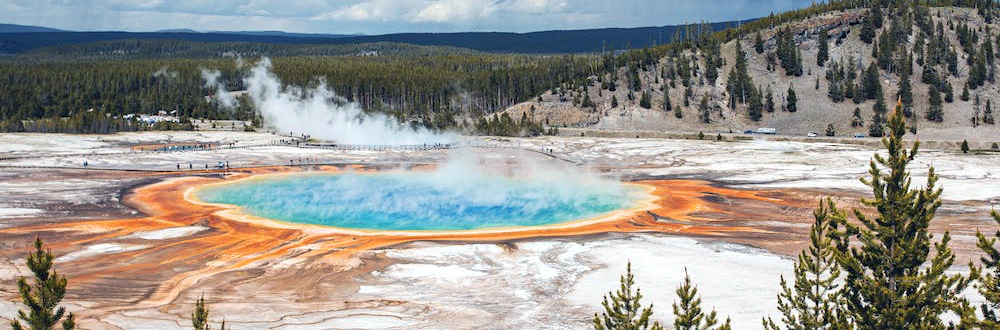
As the largest hot spring in the United States, Grand Prismatic Spring is one of the most striking and photographed natural wonders in Yellowstone. Situated in the Midway Geyser Basin, this massive pool spans roughly 370 feet across and plunges to a depth of 160 feet. Its famous rainbow rings, ranging from deep cobalt blue to vivid greens, yellows, and fiery oranges, are created by heat-loving microbial mats thriving in the mineral-rich waters. Visitors can walk along the elevated boardwalks to witness steam rising above the brilliant colors or hike to the nearby overlook.
Covering over 136 square miles, Yellowstone Lake is the largest high-elevation body of water in the park. Formed by ancient glacial activity and volcanic shifts, its crystal-clear waters offer sweeping views of surrounding mountain peaks and dense pine forests. Visitors can set out on guided boat tours to explore the lake's quiet islands while learning about its unique geothermal geology. The shoreline is a favorite hub for kayaking and scenic cruises, while anglers flock to these chilly waters for world-class cutthroat and lake trout fishing.
Situated in the park's northwestern corner, Mammoth Hot Springs is a fascinating geothermal area defined by its massive travertine terraces. Unlike other thermal basins in Yellowstone, these colorful, stair-step pools were formed over centuries as volcanic heat dissolved underground limestone. Because mineral-rich water constantly shifts its flow, the vibrant white and orange formations change continuously, making every visit distinct. Guests can explore both the Upper and Lower Terraces along an extensive network of wooden boardwalks.
Known as the "Serengeti of North America," Lamar Valley is a vast, sweeping basin in Yellowstone famous for its unmatched wildlife viewing. The open grasslands shelter massive herds of bison, elk, and pronghorn, which in turn draw native predators like grizzly bears and wolf packs. Its expansive vistas offer photographers and nature lovers some of the best viewing opportunities in the country. Visitors can traverse the valley along the main park road, pull off at scenic turnouts with spotting scopes, or join guided eco-tours for deeper insight into the local ecology.
Situated near the park's center, Norris Geyser Basin is Yellowstone's hottest and most dynamic thermal area, home to over 500 active features. The basin is famous for its vibrant mineral pools and Steamboat Geyser, the world's tallest active geyser, which can shoot boiling water up to 300 feet into the air. Because the underlying thermal activity changes constantly, new vents and acidic pools frequently form throughout the landscape. Visitors can safely explore both Porcelain Basin and Back Basin via a network of wooden boardwalks and gravel trails that offer incredible close-up views.
Fed by the roaring Yellowstone River, Yellowstone Falls is a dramatic highlight set within the park’s colorful Grand Canyon. The waterfall consists of two major drops: the Upper Falls, plunging 109 feet, and the massive Lower Falls, which drops 308 feet down steep, pastel-hued canyon cliffs. Surrounded by dense pine forests and dramatic rock formations, it is one of the most photographed natural landmarks in the region. Visitors can enjoy sweeping views from drive-up overlooks like Artist Point or hike down scenic trails to stand right at the brink of the falls.
Stretching between Yellowstone Lake and the Grand Canyon, Hayden Valley is a sweeping, scenic sanctuary famous for its dense wildlife populations. The lush river basin is a prime gathering spot for large bison herds and elk, making it one of the best locations in the park to spot grizzly bears and wolves. Running through the heart of the valley, the Yellowstone River creates picturesque marshlands and tranquil fishing spots. Visitors can park at multiple roadside pullouts along the main thoroughfare to soak in panoramic valley views or scan the landscape with binoculars.
Perched on the south rim of the Grand Canyon of the Yellowstone, Artist Point offers one of the most celebrated vistas in the entire park. Reached via a short, paved walk, the overlook opens up to a breathtaking view of the 308-foot Lower Falls framing yellow and pink canyon walls. The site was named in honor of landscape artist Thomas Moran, whose 19th-century watercolor paintings captured the region's raw beauty and helped inspire Congress to establish Yellowstone as the world's first national park. Today, it remains an essential stop for photographers and sightseers alike.
Stretching over 24 miles long and plunging more than 1,200 feet deep, the Grand Canyon of the Yellowstone is a breathtaking geological marvel carved by the Yellowstone River. Hydrothermal activity has oxidized the iron in the canyon walls over thousands of years, painting the towering cliffs in striking shades of yellow, orange, and red. At the heart of the canyon, the river cascades over the dramatic 308-foot Lower Falls. Visitors can take in panoramic vistas from North and South Rim Drives or hike along rim trails to popular overlooks like Inspiration Point and Artist Point.