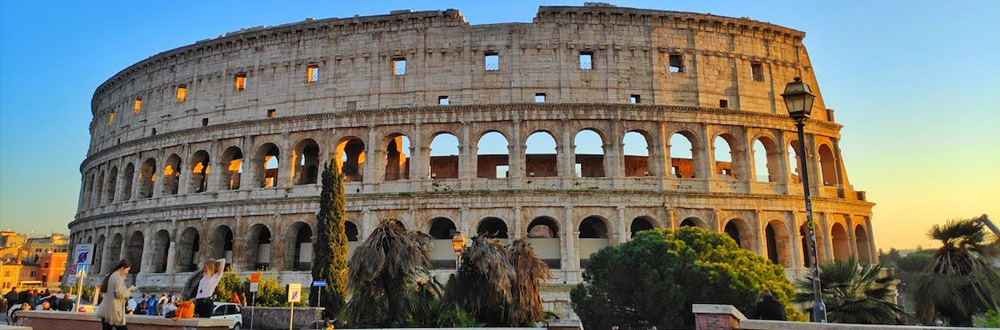
Rome, Italy's vibrant capital, stands as an enduring global destination rich in ancient history, world-class art, and culinary tradition. Visitors can explore iconic monuments of the Roman Empire, including the Colosseum, Roman Forum, and Pantheon, or admire Renaissance masterpieces within the Vatican Museums and Sistine Chapel. Beyond its historic landmarks, the city offers authentic cultural experiences throughout the cobblestone streets of the Trastevere district, lined with traditional trattorias, outdoor cafes, and espresso bars.
Constructed in 80 AD, the Colosseum stands as the largest amphitheater ever built and an enduring icon of ancient Roman engineering. Officially known as the Flavian Amphitheatre, this monumental stone and concrete structure once held up to 80,000 spectators for gladiatorial games, mock sea battles, and public executions. Despite suffering significant earthquake damage and centuries of stone looting, the surviving exterior tiers and underground hypergaeum passages continue to captivate millions of travelers annually as a powerful symbol of imperial Rome.
Situated between the Palatine and Capitoline Hills, the Roman Forum served as the political, commercial, and religious center of ancient Rome for centuries. Spanning over two millennia of history, this sprawling archaeological valley hosted public speeches, criminal trials, triumphal processions, and Senate debates that shaped the Western world. Today, visitors can walk along the ancient Via Sacra to examine preserved ruins, including the Temple of Saturn, the Arch of Septimius Severus, and the Curia Julia, offering a vivid look into daily life during the height of the Roman Empire.
The Pantheon remains one of the best-preserved architectural marvels of the ancient world. Originally commissioned by Marcus Agrippa as a temple dedicated to all Roman deities, the structure features a massive unreinforced concrete dome that stands as the largest of its kind in existence. At its apex, a central nine-meter opening known as the oculus casts natural sunlight across marble floors and ornate interior tombs, including that of the Renaissance painter Raphael. Consecrated as a Catholic basilica in 609 AD, the landmark continues to showcase ancient engineering precision.
Spanning over four miles of corridors within Vatican City, the Vatican Museums house one of the world's most extensive collections of art and historical artifacts accumulated by popes throughout the centuries. Established in the early 16th century by Pope Julius II, the complex contains 54 galleries showcasing classical Roman sculptures, ancient Egyptian antiquities, Renaissance tapestries, and masterworks by Raphael. The highlight of the route leads visitors through the papal apartments directly to the Sistine Chapel, featuring Michelangelo's legendary ceiling frescoes and The Last Judgment.
Located in Vatican City's Apostolic Palace, the Sistine Chapel serves as the official site of the papal conclave and one of the world's most celebrated artistic treasures. Commissioned by Pope Sixtus IV in the late 15th century, the chapel is renowned for its High Renaissance masterpieces. Michelangelo painted the monumental ceiling between 1508 and 1512, depicting central stories from Genesis, including The Creation of Adam. He later returned to paint The Last Judgment on the altar wall, complementing additional frescoes by Renaissance masters like Botticelli and Perugino.
Located in Vatican City, St. Peter's Basilica stands as the spiritual center of Roman Catholicism and one of the largest churches in the world. Constructed over the 16th and 17th centuries by Renaissance and Baroque architects including Bramante, Michelangelo, and Bernini, the basilica sits directly over the tomb of Saint Peter. Highlights include Michelangelo's iconic soaring dome, his revered marble sculpture La Pietà, and Bernini's massive bronze baldachin over the papal altar. Serving as the burial site for dozens of popes, the historic basilica remains an essential landmark.
Designed by Nicola Salvi and completed in 1762, the Trevi Fountain is Rome's largest and most famous Baroque water feature. Standing over 85 feet high and 160 feet wide, this monumental travertine structure marks the terminal point of the ancient Aqua Virgo aqueduct. Its elaborate center sculptures depict Oceanus, the titan god of water, flanked by Tritons taming wild sea horses. Millions of visitors carry out the famous tradition of tossing a coin into the basin with their right hand over their left shoulder to ensure a future return to the Eternal City.
Built between 1723 and 1725, the Spanish Steps comprise a monumental 135-step staircase connecting the Piazza di Spagna to the Trinità dei Monti church at the top. Designed by architects Francesco de Sanctis and Alessandro Specchi, the soaring Baroque structure was funded by a French diplomat to link the Bourbon Spanish Embassy below to the French monastery above. At the base sits the famous Fontana della Barcaccia, a fountain designed by Pietro Bernini. Positioned in Rome's premier luxury shopping district near Via dei Condotti, the landmark remains a classic gathering spot.
Built on the former site of the Stadium of Domitian from the 1st century AD, Piazza Navona retains the elongated oval shape of the ancient athletic arena. During the 17th century, Pope Innocent X transformed the open space into a masterpiece of Roman High Baroque architecture, highlighted by Gian Lorenzo Bernini's central Fontana dei Quattro Fiumi (Fountain of the Four Rivers). The square features two additional fountains, the Sant'Agnese in Agone church designed by Francesco Borromini, and vibrant outdoor cafes, making it one of the city's most lively gathering places.
Commissioned by Emperor Hadrian as a family mausoleum between 135 and 139 AD, Castel Sant'Angelo is a massive cylindrical fortress standing along the Tiber River near Vatican City. Over nearly two millennia, the structure was transformed into a papal fortress, a medieval prison, and a secure refuge connected to the Vatican via the fortified Passetto di Borgo passage. Today, the complex showcases papal apartments, Renaissance frescoes, and military artifacts, topped by a sweeping rooftop terrace beneath the iconic bronze statue of Archangel Michael offering panoramic views of Rome.