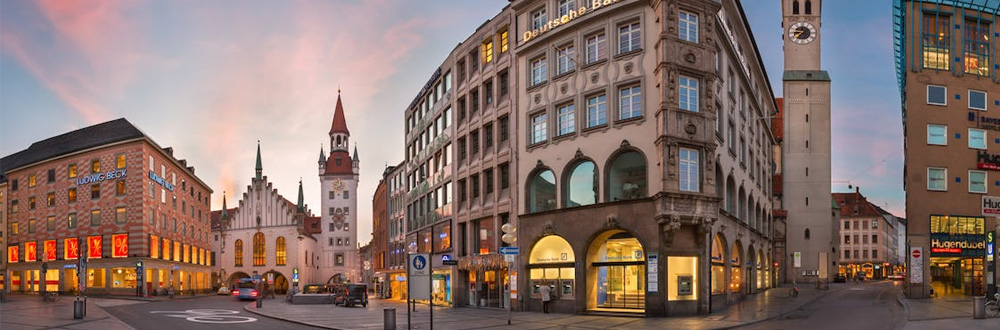
Situated along the Isar River, Munich serves as Bavaria's capital and Germany's third-largest city. Renowned for a exceptional quality of life, the metropolis balances a powerhouse economy driven by technology and engineering with deeply rooted Bavarian traditions. Historic architecture defines the city center around Marienplatz, while sprawling green spaces like the Englischer Garten offer urban relaxation. Home to world-class museums, historic beer halls, and iconic landmarks, Munich stands as a premier European destination blending modern innovation with rich historical charm.
Marienplatz is the city's central square and primary gathering point. The plaza is dominated by the majestic Neues Rathaus, home to the famous Glockenspiel clock tower whose motorized figurines reenact Bavarian history daily. Surrounding pedestrian streets offer lively outdoor cafes, local boutiques, street performers, and seasonal events like the traditional Christmas Market. Well-connected by public transit, Marienplatz provides an ideal starting point for exploring historic architecture, shopping districts, and authentic Bavarian culture in central Munich.
Spanning over nine hundred acres from the city center, the Englischer Garten is one of the world's largest urban parks. Designed in an informal English landscape style, this sprawling green space offers an ideal escape for locals and visitors alike. Highlights include watching river surfers tackle the famous standing wave on the Eisbach river, enjoying panoramic city views from the hilltop Monopteros temple, and relaxing at the massive beer garden surrounding the historic Chinese Tower. The park provides an expansive natural retreat in central Munich.
Established in 1589, the Hofbräuhaus stands as Munich's most famous beer hall and a historic icon of Bavarian culture. Inside the bustling ground-floor Schwemme, guests drink beneath painted vaulted ceilings while traditional brass bands play live music. Visitors typically enjoy a one-liter Maß of house-brewed lager alongside oversized pretzels, surrounded by regular patrons storing personal steins in locked iron lockers. Upstairs features an elegant festive hall, while a quiet outdoor courtyard beer garden offers a relaxed atmosphere away from the lively main hall crowds.
Located steps from Marienplatz, the Viktualienmarkt is Munich's premier open-air food market, operating continuously since 1807. Marked by a central blue-and-white Bavarian maypole, this lively 140-stall plaza offers fresh produce, artisanal cheeses, cured meats, and regional delicacies. Visitors gather to sample local specialties or enjoy a meal at the central outdoor beer garden, famous as the only site downtown rotating beers from Munich's six historic major breweries. The market remains an essential destination for experiencing authentic Bavarian culinary traditions and vibrant local life.
The Deutsches Museum stands as the world's largest science and technology museum. Spanning over half a million square feet, the vast facility highlights centuries of German engineering and innovation. Interactive exhibition halls cover fifty distinct disciplines, featuring popular attractions like the expansive aviation hall, historical marine displays, and an immersive replica of a subterranean coal mine. Visitors can explore groundbreaking historical artifacts, participate in hands-on science demonstrations, and experience a comprehensive overview of global technological progress.
Commissioned in 1664, Nymphenburg Palace is a sprawling Baroque masterpiece that served as the primary summer residence for Bavarian rulers. The grand palace features a facade wider than Versailles, housing ornate interiors such as the central Stone Hall with grand Rococo ceiling frescoes and King Ludwig I's famous Gallery of Beauties. Surrounding the palace, a 490-acre manicured park contains scenic canals, fountains, and hidden forest pavilions. Visitors can tour the royal apartments, visit the onsite carriage museum, and stroll the extensive historic gardens.
Housed in a striking silver bowl near Olympiapark, the BMW Museum tracks over a century of automotive engineering and innovation. Inside, a continuous spiral ramp guides visitors through exhibits displaying iconic historic automobiles, motorcycles, racing prototypes, and futuristic concept vehicles. Highlights include the performance M-series gallery and vintage engines. Across an adjacent footbridge, BMW Welt offers free entry where visitors can sit inside the latest production models and experience modern vehicle handovers.
Built for the 1972 Summer Games, Olympiapark remains an iconic masterclass in modern urban design and architecture. The sprawling complex is world-renowned for its revolutionary, sweeping acrylic glass canopy roofs drapes over the main stadium, hall, and aquatic center. Today, the park serves as a major recreational hub featuring scenic walking paths, a boating lake, and event venues. Visitors can take guided roof climbs along the stadium canopy, attend concerts, or ride the elevator up the 291-meter Olympic Tower for sweeping panoramic views of the Munich skyline and distant Alps.
Situated two hours southwest of Munich, Neuschwanstein Castle is a iconic 19th-century fortress built by King Ludwig II. Famous for inspiring Disney's Sleeping Beauty castle, this fairytale landmark sits dramatically above the Pöllat Gorge in the Bavarian Alps. Advance online tour reservations are essential as interior tickets sell out quickly. Visitors can hike up from Hohenschwangau village and cross Marienbrücke for panoramic views of the castle towers, surrounding lakes, and mountain peaks, making it Munich's premier alpine day trip destination.
Twenty-five minutes northwest of Munich, the Dachau Concentration Camp Memorial offers a sobering historical experience. Opened in 1933, Dachau served as the first Nazi concentration camp and became the structural prototype for all subsequent camps. Today, visitors can explore the former maintenance building housing detailed historical exhibits, walk past reconstructed inmate barracks, and view the memorial chapels and crematorium area. Given the profound nature of the exhibits, the site recommends visitors be at least fourteen years old to undertake this essential day trip.