Ljubljana, the capital of Slovenia, pairs rich medieval history with a vibrant, eco-friendly urban atmosphere. Nestled along the Ljubljanica River, its compact, pedestrian-only Old Town features a striking mix of Baroque structures, Art Nouveau facades, and iconic urban design by architect Jože Plečnik. Overlooked by the hilltop Ljubljana Castle, the city pulses with open-air markets, riverside cafes, and a thriving contemporary arts scene. Celebrated as one of Europe’s greenest capitals, Ljubljana offers sprawling public parks like Tivoli, making it an inviting, walkable destination.
Perched high on Castle Hill above the city center, Ljubljana Castle is a medieval fortress with origins stretching back to the 11th century. Rebuilt in the 15th century to defend against Ottoman invasions, the historic complex now serves as a cultural hub for art exhibitions, museum displays, and open-air summer concerts. Visitors can reach the fortress via a scenic funicular railway to explore the Gothic Chapel of St. George, historic prison cells, and the interactive Museum of Slovenian History. Its crowning feature, the Outlook Tower, offers breathtaking 360-degree views across Old Town.
Spanning the Ljubljanica River to link Prešeren Square directly with Old Town, the Triple Bridge (Tromostovje) is an architectural masterpiece designed by Jože Plečnik. Originally a single 1842 stone bridge, Plečnik added two flanking pedestrian bridges and stone balustrades between 1929 and 1932 to seamlessly manage foot traffic. Today, the car-free crossing serves as Ljubljana's central meeting point, bordered by Poplar trees and historic cafes. Its distinct Venice-inspired balustrades and classic street lamps make it an essential starting landmark for exploring the capital on foot.
Prešeren Square serves as the vibrant central plaza and primary meeting point of Ljubljana. Named after France Prešeren, Slovenia's national poet, the pedestrian square features a prominent 1905 bronze monument depicting the poet alongside a muse. Bounded by the striking salmon-pink Franciscan Church of the Annunciation and ornate Art Nouveau structures like the Hauptman House, the plaza links the modern commercial center directly to the historic Old Town via the Triple Bridge. It remains the heart of civic life, regularly hosting street performers, cultural events, and public gatherings.
Dragon Bridge (Zmajski most) is an iconic Art Nouveau bridge completed in 1901 as one of Europe's earliest reinforced concrete structures. Originally named the Franz Josef I Jubilee Bridge, it is guarded at its four corners by fierce sheet-copper dragon statues, reflecting the mythical creature featured on Ljubljana's coat of arms. Designed by Dalmatian architect Jurij Zaninović, the bridge features original floral relief carvings, ornate sheet-iron lamps, and decorated balustrades. Adjacent to the Central Market, it serves as a functional vehicle crossing and one of the city's most recognized landmarks.
Ljubljana Cathedral stands as the principal seat of the Archdiocese. Rebuilt in the early 18th century to plans by Jesuit architect Andrea Pozzo, the cathedral is a classic example of High Baroque architecture, featuring double bell towers and a green copper dome. Its interior houses vibrant ceiling frescoes by Giulio Quaglio, intricate gilded plasterwork, and a monumental marble altar. The cathedral is renowned for its 20th-century relief-sculpted bronze doors: the main Slovenian Door depicting 1,200 years of national Christian history, and the side Ljubljana Door honoring papal visits.
Tivoli Park is Ljubljana's largest public park, spanning five square kilometers directly west of the city center. Designed in 1813 by French engineer Jean Blanchard during the Napoleonic era, the green space connects the downtown core directly to the forested slopes of Rožnik Hill. Its central axis, the Jakopič Promenade, was redesigned by architect Jože Plečnik into an open-air photography exhibition space leading to the 17th-century Neoclassical Tivoli Castle. The expansive grounds feature formal geometric flower gardens, a fish pond, greenhouse conservatories, and extensive walking trails.
The National Gallery of Slovenia serves as the nation's premier historical art museum, housed in an 1896 Neoclassical palace. The collection spans from the High Middle Ages through the early 20th century, displaying medieval religious panel paintings, Gothic wooden sculptures, and masterworks by Slovenian Impressionists like Rihard Jakopič and Ivan Grohar. Expanded in 2001 with a modern glass wing connecting the historical building to the Club of Delegates, the gallery houses the original 1751 marble Robba Fountain (Fountain of the Three Carniolan Rivers).
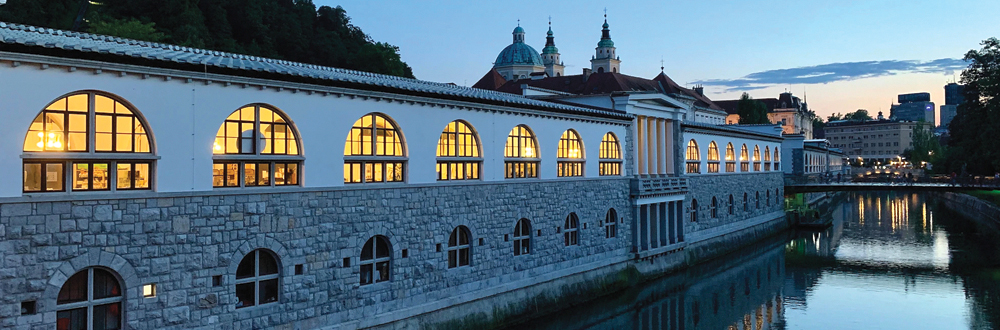
Ljubljana Central Market is a sprawling food market designed by master architect Jože Plečnik between 1940 and 1944. Stretching along the Ljubljanica River between the Triple and Dragon bridges, the complex features a two-story Renaissance-inspired stone colonnade housing butcher shops, bakeries, and dairy vendors, alongside an expansive open-air square for produce, flowers, and local honey. Built on the site of a former diocesan college destroyed in the 1895 earthquake, the market functions as both an architectural landmark and the daily provisions hub for local residents.
The Ethnographic Museum serves as the national museum of everyday life, preserving traditional customs, folk arts, and material heritage across Slovenia and international cultures. Established in 1923, the museum is housed in a restored 19th-century Austro-Hungarian military barracks complex.. Its permanent collections feature over 40,000 artifacts, including traditional costumes, rural agricultural tools, hand-painted beehive panels, pottery, and ceremonial masks. It operates as a primary cultural center for the documentation and preservation of Slovenian folk traditions and social history.
Ljubljana Zoo is a 19.6-hectare natural sanctuary situated at the southern base of Rožnik Hill within the Tivoli, Rožnik, and Šiška Hill Landscape Park. Established in 1949, the facility utilizes the natural pine and beech forest terrain to house over 500 animals across 119 species, emphasizing indigenous European wildlife alongside global fauna such as brown bears, lynx, cheetahs, and Asian elephants. Located approximately 20 minutes on foot from the city center, the zoo integrates native woodland habitats with interactive education programs, focusing on species conservation and biodiversity.