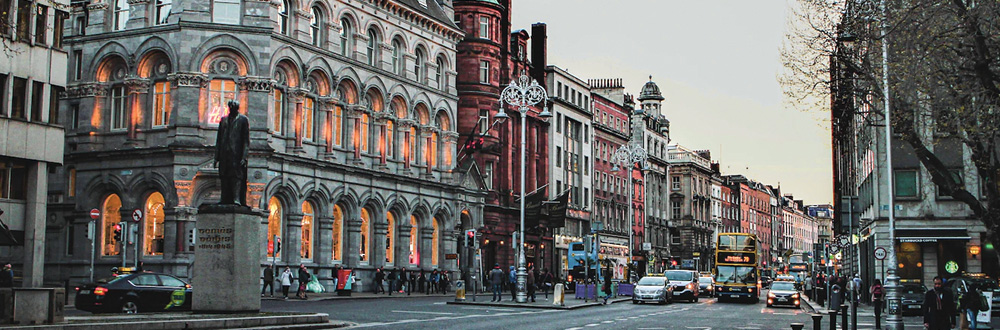
Dublin seamlessly bridges centuries of rich history with a dynamic modern energy. Evolving from a 9th-century Viking settlement into a vibrant cosmopolitan capital, the city captivates visitors with its picturesque streets, Georgian architecture, and iconic colorful doorways. Renowned for its literary heritage that shaped figures like James Joyce and Oscar Wilde, Dublin offers a world-class arts scene filled with historic theaters, galleries, and museums. Driven by the legendary warmth and welcoming "craic" of its locals, Ireland's capital provides a blend of tradition, culture, and urban life.
Standing in the heart of the city, Dublin Castle is a monumental landmark that encapsulates centuries of Irish history. Originally constructed as a medieval fortress in the 13th century on a former Viking site, the complex evolved into a striking blend of medieval and Georgian architecture, serving for centuries as the seat of British rule in Ireland. Visitors can explore the opulent State Apartments—adorned with lavish furnishings and intricate artwork—to uncover tales of power and resilience. Outside, the peaceful Castle Gardens offer a tranquil green oasis in the center of the bustling capital.
Situated on Bow Street in the heart of Dublin, the Jameson Distillery offers an immersive journey into the history and heritage of Irish whiskey. Housed in the brand's original 1780 site, the historic distillery guides visitors through the full craft of whiskey-making—from grain selection and triple distillation to barrel maturation. Through interactive, sensory tours and comparative tastings, guests gain deep insight into the art of blending that gives Jameson its signature smoothness. Combining rich legacy with expert-led experiences, it remains a premier destination for whiskey lovers exploring the capital.
The Guinness Storehouse is an immersive, seven-story museum dedicated to Ireland's legendary stout. Built around a glass atrium shaped like a giant pint, the former fermentation plant walks visitors through the brewing process, from sourcing four natural ingredients to mastering the art of the perfect pour. Interactive exhibits highlight the brand's vintage advertising campaigns and rich heritage dating back to Arthur Guinness in 1759. The tour culminates at the top-floor Gravity Bar, where guests can enjoy a complimentary pint alongside sweeping 360-degree panoramic views.
Stretching along the south bank of the River Liffey, Temple Bar is Dublin’s premier cultural quarter and nightlife hub. Renowned for its medieval cobblestone streets and historic facades, this energetic neighborhood comes alive with traditional music pouring from historic pubs. Beyond its famed pub culture, the district serves as a creative sanctuary, hosting independent art galleries, contemporary theaters like, vibrant street art, and eclectic weekend markets filled with crafts and artisanal foods. It remains an essential destination for experiencing Dublin's artistic spirit.
Founded in 1191 in honor of Ireland’s patron saint, St. Patrick's Cathedral is the largest church in the country and a masterpiece of Gothic architecture. This awe-inspiring cathedral features soaring stone vaulted ceilings, vibrant stained-glass windows, and intricate monuments tracing centuries of Irish history. Visitors can explore its rich literary connection as the burial place of Gulliver's Travels author Jonathan Swift, who served as dean in the 18th century. Surrounded by peaceful, landscaped gardens, the cathedral stands as both a spiritual sanctuary and an iconic pillar of Dublin's cultural identity.
Opened in 1796 and decommissioned in 1924, Kilmainham Gaol stands as a monumental symbol of Ireland’s struggle for independence. This former Victorian prison held generation after generation of Irish revolutionaries, including the leaders of the 1916 Easter Rising who were executed within its walls. Guided tours take visitors through its austere corridors, stark cell blocks, and the historic Stonebreakers' Yard. Through its striking architecture and poignant exhibits, the museum offers a powerful look into the resilience, sacrifices, and history that shaped modern Ireland.
The National Museum of Ireland offers an extraordinary journey through the nation's rich heritage. The Archaeology branch on Kildare Street houses world-renowned ancient treasures, including prehistoric gold artifacts, intricate Celtic metalwork like the Ardagh Chalice, and remarkably preserved Viking relics. Additional branches dedicated to Decorative Arts, History, and Natural History showcase everything from military history to centuries of fine Irish craftsmanship. Together, these curated collections provide a comprehensive look at Ireland's deep cultural evolution and global connections.
Opened in 1831 inside the lush grounds of Phoenix Park, Dublin Zoo is Ireland's largest wildlife attraction and one of the world's oldest zoos. Spanning over 68 acres, the park features expansive, naturalistic habitats designed to support global conservation efforts and species preservation. Visitors can explore immersive zones like the African Plains and Asian Rainforest, which house Asian elephants, gorillas, sea lions, and playful penguins. Combining rich history with modern educational programs, it provides a world-class experience for animal lovers of all ages.
The National Gallery of Ireland houses the nation's premier collection of Irish and European fine art spanning the 13th to the 20th centuries. Across four interconnected wings, the gallery features iconic masterpieces such as Caravaggio's The Taking of Christ, Vermeer's Lady Writing a Letter with her Maid, and vibrant Impressionist works by Claude Monet. Exceptional collections of Irish art, including extensive works by Jack B. Yeats, sit alongside Italian Renaissance and Dutch Golden Age treasures. Offering free admission to its permanent collection, the gallery remains an essential cultural hub.
The Oscar Wilde House is the grand Georgian townhouse where the famed playwright and wit spent his formative childhood years. Though the interior functions as a academic and cultural facility and is generally closed to the public, the restored exterior remains a mandatory pilgrimage site for literary enthusiasts. Overlooking Merrion Square Park—where a famous, colorful statue of Wilde reclines nearby on a granite boulder—the historic residence stands as a permanent tribute to one of Dublin's most iconic literary figures and his indelible legacy on world literature.