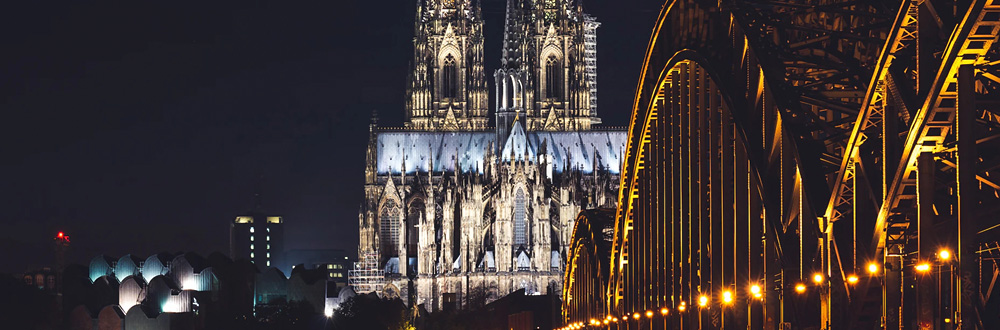
Situated along the Rhine River in western Germany, Cologne is a major cultural and economic hub founded by the Romans in 38 BCE as Colonia Claudia Ara Agrippinensium. The city's defining landmark is the Gothic Cologne Cathedral, a UNESCO World Heritage site featuring twin 157-meter spires and the medieval Shrine of the Three Kings. Home to prominent institutions like the Museum Ludwig, Cologne balances its ancient foundations with modern industry, media, and vibrant local traditions—most notably its historic Kölsch brewing culture and annual Carnival celebrations.
Cologne Cathedral is a UNESCO World Heritage site and Germany's most visited landmark, standing 157 meters high as the tallest twin-spired church in the world. Construction began in 1248 on the site of a 4th-century Roman church and proceeded in phases until its final completion in 1880. Designed in the High Gothic style, the cathedral houses the Shrine of the Three Kings, a gilded 12th-century reliquary created by Nicholas of Verdun, alongside the 10th-century Gero Cross. Located adjacent to the Central Station, it remains the principal seat of the Archbishop of Cologne.
The Hohenzollern Bridge is a three-arched steel railway and pedestrian bridge crossing the Rhine River, handling over 1,200 trains daily. Constructed between 1907 and 1911 to replace the earlier Cathedral Bridge, the structure was rebuilt following World War II destruction and expanded with additional tracks in the late 20th century. Flanked by equestrian statues of Prussian kings and German emperors, the bridge is recognized for thousands of padlocks attached to the pedestrian walkways, offering direct foot access between Cologne Central Station and the Cologne Triangle viewpoint.
Located adjacent to Cologne Cathedral and the Rhine River, Museum Ludwig is a major institution for 20th and 21st-century art. Established in 1976 through a gift by Peter and Irene Ludwig, the museum holds the world's third-largest collection of Pablo Picasso works. It features Europe's most extensive holdings of American Pop Art—including pieces by Andy Warhol, Roy Lichtenstein, and Jasper Johns—alongside significant collections of Russian Avant-Garde paintings, German Expressionism, and over 70,000 historic photographs within the Agfa-Foto-Historama section.
Cologne's Old Town is a historic district situated along the western bank of the Rhine River, centered around the Alter Markt and Heumarkt squares. Rebuilt following extensive damage in World War II, the district retains its medieval street grid lined with restored traditional townhouse facades, municipal halls, and local Kölsch brewpubs. Its defining landmark is the Great St. Martin Church (Groß St. Martin), a Romanesque basilica built between 1150 and 1240 over the remains of Roman storehouses. The area connects the city's ancient roots directly to the modern Rhine riverfront promenade.
The Cologne Chocolate Museum is an interactive exhibition space situated on the Rhine River peninsula in the Rheinauhafen district. Founded in 1993 by Hans Imhoff, the 4,000-square-meter facility details the 5,000-year history of cocoa, featuring a 10-meter-high glass tropical greenhouse, historical production machinery, and a working miniature factory line operated in partnership with Lindt & Sprüngli. Its centerpiece is a three-meter-tall golden chocolate fountain containing 200 kilograms of warm chocolate for visitor tastings. The museum stands as one of Germany's most visited attractions.
Great St. Martin Church is a Romanesque Catholic basilica situated in Cologne's Old Town, constructed between 1150 and 1240. Built as a Benedictine monastery church, its exterior is defined by a four-tiered crossing tower flanked by four corner turrets that dominate the riverfront skyline. The restored interior features stone walls and minimal ornamentation, reflecting traditional monastic simplicity alongside surviving Roman foundation ruins accessible in the crypt below. Completely rebuilt after sustaining severe bombing damage during World War II, the church remains an active place of worship.
Lindenthaler Stadtwald is a 150-hectare public park and nature reserve situated in Cologne's western Lindenthal district. Established in the early 20th century, the park is defined by expansive beech and oak forest trails, two major artificial lakes, and extensive walking networks. A central feature is the Lindenthal Wildpark, an open-access game enclosure housing native European species including fallow deer, sika deer, and waterfowl. Situated along the Dürener Straße corridor, the park provides recreational access, forested trails, and open meadow space for the surrounding residential area.
Cologne Zoo is a 20-hectare zoological garden housing over 10,000 animals across more than 850 species. Founded in 1860, it is the third-oldest zoo in Germany, featuring historic 19th-century architecture alongside modern immersive habitats such as the 2-hectare Elephant Park, the indoor Hippodom, and a tropical rainforest hall. The facility operates international conservation projects, a dedicated aquarium/terrarium complex, and educational programs. Situated directly north of the city center, it remains one of the most visited zoological parks in Europe.
The LVR-LandesMuseum, located in neighboring Bonn, serves as the archaeological and cultural history museum for the Rhenish region. Founded in 1820, the museum houses collections spanning from regional prehistory to contemporary art, highlighted by the original 40,000-year-old Neanderthal skull discovered in the nearby Neander Valley in 1856. Its 6,000-square-meter exhibition space showcases Frankish grave goods, Roman provincial artifacts, medieval stone sculptures, and Rhenish paintings, documenting the cultural evolution of the Rhineland from the Stone Age to the modern era.
The Cologne Cable Car is a 935-meter aerial tramway spanning the Rhine River, connecting the Cologne Zoo and Flora Botanical Garden on the left bank to Rheinpark on the right bank. Opened in 1957 for the Federal Deciduous Garden Exhibition (Bundesgartenschau), it was Europe's first cable car to cross a river. Operating seasonally from March through November, the system features 44 four-passenger cabins traveling at heights up to 50 meters above the water, providing a scenic 6-minute transit link and aerial view between these two key municipal recreational areas.