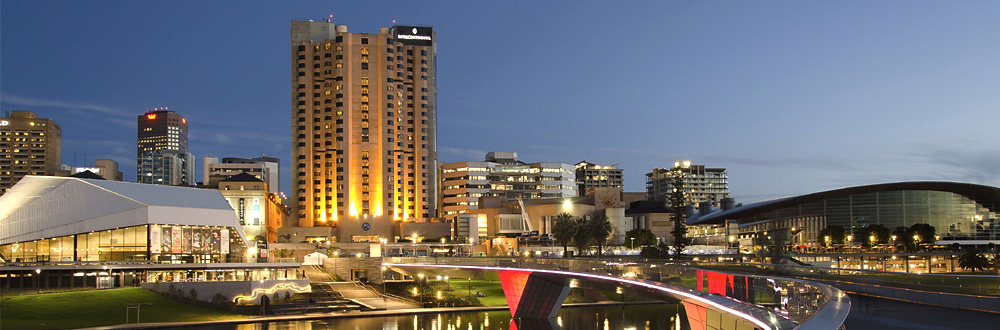
Adelaide is the capital city of South Australia, situated on the Adelaide Plains. Founded in 1836, the planned city features a grid layout designed by Colonel William Light, ringed entirely by 760 hectares of continuous public parklands. As the state's commercial and cultural hub, Adelaide houses key heritage assets, including the North Terrace cultural precinct, Adelaide Botanic Garden, and Adelaide Central Market. The city serves as a primary hub for regional agricultural commerce, biomedical research, and direct access to South Australia's wine-producing regions.
Adelaide Central Market is an iconic indoor produce hall located in the central business district of Adelaide, bounded by Grote Street and Gouger Street. Established in 1869 as the City Market, it stands as one of Australia’s oldest continuously operating food markets. Owned and managed by the City of Adelaide, the venue spans over 5,700 square meters and houses more than 70 independent traders. The market functions as South Australia's primary urban culinary hub, distributing fruit, vegetables, meat, seafood, cheeses, and artisan goods to over eight million visitors annually.
The South Australian Museum is a natural history museum and research institution. The complex comprises five heritage-listed buildings, including the 1884 Jervois Wing and the 1895 North Wing. The institution holds over four million biological, geological, and cultural specimens, featuring the world’s largest collection of Australian Aboriginal cultural artifacts. Permanent exhibits include the Australian Aboriginal Cultures Gallery, the Mawson Gallery documenting Antarctic exploration, and extensive Ediacaran fossil displays showcasing the planet's earliest complex multicellular life.
Art Gallery of South Australia (AGSA) is a major public art museum located on North Terrace in central Adelaide. The institution occupies a heritage-listed complex anchored by an 1899 neoclassical building designed by C.E. Owen Smyth. The gallery holds a collection of over 45,000 works of art, representing one of Australia's largest public art collections. AGSA is notable for its extensive holdings of Australian art, including comprehensive Aboriginal and Torres Strait Islander works, alongside significant European, Asian, and international contemporary collections.
Adelaide Botanic Garden is a 51-hectare public botanical reserve located in the northeastern corner of the Adelaide city center. Opened in 1857, the heritage-listed grounds feature Victorian-era architecture, curated plant collections, and historic glasshouses. Key structures include the 1877 Palm House, a restored German-built iron greenhouse, the Santos Museum of Economic Botany, and the Bicentennial Conservatory, which houses a lowland tropical rainforest ecosystem. The site serves as a vital center for botanical research, plant conservation, and horticulture education.
Adelaide Zoo is an 8-hectare park located along the River Torrens bordering the Adelaide Botanic Garden. Opened in 1883, it is Australia's second-oldest zoo and is operated by the non-profit Royal Zoological Society of South Australia. The facility houses over 2,500 animals representing 250 species, notably featuring Australasia's only giant panda enclosure precinct. Key heritage features include the Minchin House administration building and the historic central rotunda, with exhibits organized into geographic precincts focusing on South-East Asian, African, and native Australian wildlife.
Glenelg Beach is a prominent urban foreshore located along Holdfast Bay, 10 kilometers southwest of central Adelaide. Situated at the terminus of the historic Glenelg Tram line, the white-sand beach serves as the site of mainland South Australia's first official European settlement in 1836. The precinct is anchored by the 215-meter Glenelg Jetty, the Moseley Square civic plaza, and the timber-framed Town Hall. Maintained as a primary coastal recreation sector, the area integrates marine tourism, commercial dining corridors, and heritage maritime reserves.
Hahndorf is a historic township in the Adelaide Hills, located 28 kilometers southeast of Adelaide. Established in 1839 by Lutheran immigrants from Prussia, it stands as Australia's oldest surviving German settlement. The town's main thoroughfare retains original 19th-century timber-framed architecture and historic elm trees. Heritage sites include The Academy museum and The Heysen Estate at the Cedars, former home of artist Sir Hans Heysen. The surrounding district functions as a cool-climate wine region, specializing in Sauvignon Blanc, Pinot Noir, and artisanal food production.
Barossa Valley is a prominent viticultural region located northeast of central Adelaide. Formed by the North Para River, the valley encompasses major townships including Tanunda, Nuriootpa, and Angaston. Established in the 1840s by German and British settlers, it stands as one of Australia's oldest and most internationally recognized wine-producing districts. The region features over 150 wineries and 80 cellar doors, specializing primarily in old-vine Shiraz, Cabernet Sauvignon, and Grenache, supported by a distinct agricultural economy rooted in Lutheran heritage and artisanal food production.
The Adelaide Hills is a geographical region and cool-climate wine district forming part of the Mount Lofty Ranges. Rising to 727 meters at Mount Lofty Summit, the area encompasses towns including Stirling, Mount Barker, and Hahndorf. Encompassing over 70 cellar doors and extensive agricultural land, the region is recognized for its high-altitude viticulture, specializing in Sauvignon Blanc, Chardonnay, and Pinot Noir. The district functions as a key conservation corridor and rural tourism center, featuring protected reserves like Belair National Park and Cleland Wildlife Park.
Kangaroo Island is Australia's third-largest island, encompassing 4,405 square kilometers southwest of Adelaide. The landmass features 509 kilometers of coastline dominated by coastal cliffs, protected bays, and wilderness areas. Over a third of the island is preserved within protected reserves, including Flinders Chase National Park, Seal Bay Conservation Park, and Cape Gantheaume Wilderness Protection Area. The isolated ecosystem supports significant breeding populations of Australian sea lions, long-nosed fur seals, tammar wallabies, and endemic Kangaroo Island kangaroos.