Thailand is a Southeast Asian nation anchored by its capital, Bangkok, a dense metropolis balancing modern urban infrastructure with major cultural landmarks. Situated in the heart of the Indochinese Peninsula with a population exceeding 70 million, the country features varied landscapes spanning mountainous northern highlands, fertile central agricultural river basins, and expansive southern coastlines along the Andaman Sea and the Gulf of Thailand. Driven by major industries in tourism, manufacturing, and agriculture, it serves as a central hub for international travel and trade.
The Grand Palace in Bangkok is a monumental 218,000-square-meter complex established in 1782 by King Rama I to mark the founding of the Chakri Dynasty. Situated along the Chao Phraya River, the grounds served as the official residence and administrative seat of the Thai monarchy for over 150 years. The walled compound demonstrates traditional Rattanakosin-style architecture with gold-leaf gilding and multi-tiered roofs. Its central sanctuary, Wat Phra Kaew, enshrines the sacred Emerald Buddha, a 15th-century image carved from a single block of jasper.
Wat Phra Kaew is Thailand's most sacred Buddhist temple. Established in 1782, the complex serves as the country's palladium and houses the revered Emerald Buddha, a 66-centimeter statue carved from solid green jasper depicting the Buddha in a meditating posture. The main ordination hall (ubosot) displays traditional Rattanakosin-style architecture featuring gilded mosaic pillars, multi-tiered roofs, and interior mural paintings detailing the Ramakien epic. As a royal chapel without resident monks, it remains the central site for national religious ceremonies presided over by the Thai monarch.
Wat Arun is a historic Buddhist temple dating to the Ayutthaya Kingdom. Reconstructed in the early 19th century under Kings Rama II and Rama III, the site is defined by its central 82-meter Khmer-style tower (prang), surrounded by four smaller satellite spires. The structures are decorated with thousands of colorful porcelain pieces and seashell mosaics, which were originally used as ballast on Chinese merchant ships trading in Siam. Steep central stairways lead to upper terraces that overlook the river and the surrounding Rattanakosin district.
Chiang Mai Old City is a 1.5-square-kilometer historical square established in 1296 by King Mengrai as the capital of the Lanna Kingdom. The historic center remains demarcated by its original square moat and reconstructed brick city walls.The area contains over 30 Buddhist temples demonstrating traditional Lanna architectural elements, including Wat Chedi Luang with its 14th-century ruined stone pagoda and Wat Phra Singh, which houses the revered Phra Singh Buddha image. The neighborhood is a hub hosting walking street markets, cultural centers, and wooden heritage structures.
Doi Suthep is a sacred Theravada Buddhist temple established in 1383 atop Doi Suthep mountain, 1,053 meters above sea level west of Chiang Mai. The temple complex is accessed via a 306-step staircase flanked by carved multi-headed Naga serpents. At the center of the inner courtyard stands a gilded 24-meter Chiang Saen-style pagoda (chedi) containing relics of the Buddha. Surrounding cloisters feature detailed wall murals depicting the life and incarnations of the Buddha, along with shrine halls, ceremonial bells, and a large viewing terrace that overlooks the Chiang Mai valley.
Ayutthaya Historical Park encompasses the ruins of the second capital of the Kingdom of Siam, founded in 1350 and destroyed during the Burmese invasion of 1767. Located 80 kilometers north of Bangkok at the confluence of the Chao Phraya, Pa Sak, and Lopburi Rivers, the 289-hectare UNESCO World Heritage site includes brick monasteries, prangs, and royal palaces. Key structures within the park include Wat Phra Si Sanphet, featuring three restored 15th-century chedis, Wat Mahathat, known for a sandstone Buddha head embedded in tree roots, and Wat Ratchaburana.
Erawan Waterfall is a seven-tiered cascade situated within the 550-square-kilometer Erawan National Park in Kanchanaburi Province, western Thailand. Fed by the Mong Lai and Omtala streams, the falls drop over limestone formations across a 1.5-kilometer forested trail. The high calcium carbonate content gives the water its distinct emerald and turquoise color while creating natural plunge pools on each level. Named after the three-headed white elephant of Hindu mythology, which the top tier resembles, the site features a marked hiking route through the eastern deciduous forest.
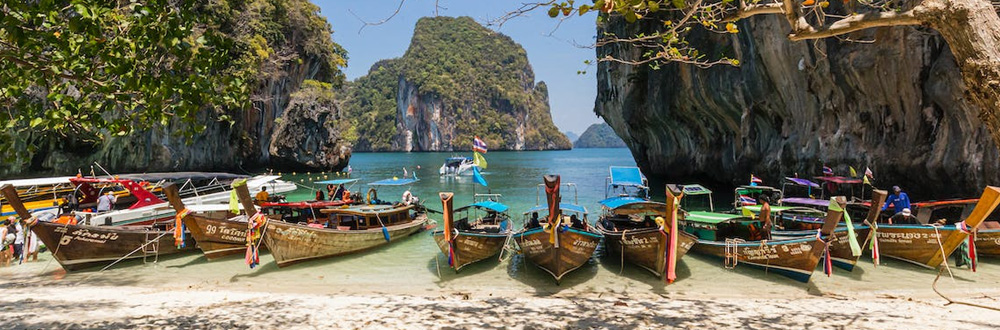
Railay Beach is a small peninsula situated in Krabi Province on the Andaman Sea, geographically isolated from the mainland by massive limestone karst cliffs that restrict access entirely to longtail boats. The area spans four main sections: Railay West, Railay East, Phra Nang Beach, and Tonsai. Known globally as a major rock-climbing destination, the peninsula features over 700 bolted climbing routes along its vertical sheer faces. The surrounding geography includes limestone caves such as Diamond Cave and a hidden interior tidal lagoon reached via a steep cliff scramble.
The Phi Phi Islands are an archipelago of six islands located in the Andaman Sea within Krabi Province, roughly 45 kilometers southeast of Phuket. The group includes Koh Phi Phi Don, the only inhabited island with commercial infrastructure and Ton Sai Bay, and Koh Phi Phi Le, an uninhabited national park reserve containing Maya Bay and Pileh Lagoon. Formed from steep limestone karst topography rising sharply from shallow marine waters, the surrounding Hat Noppharat Thara-Mu Ko Phi Phi National Park supports coral reef ecosystems, marine diving sites, and coastal cliff formations.
Sukhothai Historical Park covers 70 square kilometers in Sukhothai Province, encompassing the capital ruins of the Sukhothai Kingdom from the 13th to 15th centuries. As a UNESCO World Heritage Site, the park is divided into five zones containing 193 historical ruins. The central walled zone features Wat Mahathat, the kingdom's primary royal temple, which contains a lotus-bud chedi flanked by standing Buddha statues. Architectural elements throughout the site demonstrate the classic Sukhothai style, characterized by bell-shaped stupas, stepped bases, and bronze or stucco Buddha images.