Singapore is an island city-state in Southeast Asia situated off the southern tip of the Malay Peninsula. Encompassing a land area of 734.3 square kilometers, the sovereign nation comprises one main island and 63 maritime islets. Established as a British trading post by Stamford Raffles in 1819, Singapore gained independence in 1965 and developed into a global financial, shipping, and aviation hub. Key infrastructure includes Changi Airport, the Port of Singapore, and a 230-kilometer Mass Rapid Transit (MRT) rail network serving a population of 5.9 million.
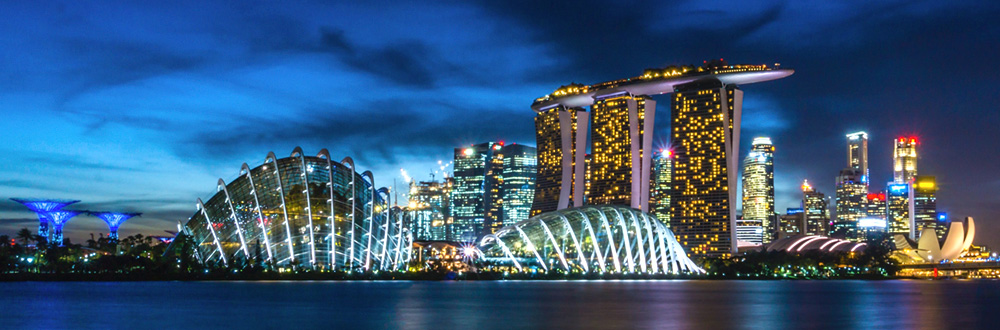
Marina Bay Sands is an integrated resort fronting Marina Bay, designed by Moshe Safdie and opened in 2010. Developed by Las Vegas Sands, the complex features three 55-story hotel towers housing 2,561 rooms, capped by the 340-meter-long SkyPark. The 1.2-hectare roof structure holds a 150-meter infinity swimming pool and a public observation deck elevated 191 meters above ground. The complex encompasses a 74,000-square-meter retail mall (The Shoppes), a 120,000-square-meter convention center, the ArtScience Museum, two floating pavilions, a casino, and two large theaters.
Gardens by the Bay is a 101-hectare nature park adjacent to the Marina Reservoir, comprising three waterfront gardens: Bay South, Bay East, and Bay Central. Opened in 2012, the park features 18 structural Supertrees ranging from 25 to 50 meters in height, which act as vertical gardens fitted with photovoltaic cells and rainwater harvesting systems. The site includes two cooled conservatories: the 1.2-hectare Flower Dome, holding the Guinness World Record as the world's largest glass greenhouse, and the Cloud Forest, housing a 35-meter indoor waterfall and a vegetated mountain structure.
Sentosa is a 5-square-kilometer island located just off the southern coast of Singapore, accessible via a causeway, boardwalk, monorail, and cable car system. Formerly a British military base, the island was renamed in 1972 and developed into a major leisure destination. Key assets include Resorts World Sentosa, an integrated resort housing Universal Studios Singapore and the S.E.A. Aquarium, alongside a 2-kilometer stretch of sheltered artificial coastline encompassing Siloso, Palawan, and Tanjong beaches, 18-hole championship golf courses, and deep-water marina facilities at Sentosa Cove.
The Singapore Botanic Gardens is an 82-hectare tropical garden established in 1859 at Cluny Road, near the Orchard Road shopping district. Designated as Singapore's first UNESCO World Heritage Site in 2015, the facility contains the National Orchid Garden, a 3-hectare enclosure displaying over 1,000 species and 2,000 hybrids. Additional primary elements include a 6-hectare primary rainforest patch, the Symphony Lake open-air concert venue, the Jacob Ballas Children's Garden, and an extensive herbarium housing more than 750,000 preserved plant specimens.
Singapore's Chinatown is a 2-square-kilometer sub-zone in the Outram district, bounded by New Bridge Road, South Bridge Road, Upper Cross Street, and Cantonment Road. Established as the Kling Kampong and Chinese Kampong, the historic enclave features preserved two and three-story Southern Chinese style shophouses. Primary structural landmarks include the 2007 Tang Dynasty-style Buddha Tooth Relic Temple and Museum, the Sri Mariamman Temple (Singapore's oldest Hindu temple), and the Chinatown Complex, which contains the country's largest hawker center.
Little India is an ethnic enclave covering roughly 0.2 square kilometers along Serangoon Road and adjacent streets within the Rochor planning area of Singapore. Formed in the 19th century around cattle trading and brick-kiln operations along the Rochor River, the district features preserved commercial shophouses and major cultural sites. Key infrastructure includes the 1881 Sri Veeramakaliamman Temple built in the South Indian Dravidian style, the Tekka Centre mixed-use facility containing a wet market and hawker center, and the Mustafa Centre retail complex spanning 37,000 square meters.
The Singapore Zoo is a 28-hectare zoological garden located along Mandai Lake Road within Singapore's central catchment area. Opened in 1973, the open-concept facility uses dry and wet moats to house over 4,200 animals across 300 species within naturalistic habitats. Key features include the free-ranging orangutan exhibit, an elevated walkway system, and specific biome zones such as Fragile Forest, Wild Africa, and Great Rift Valley of Ethiopia. The site forms part of the Mandai Wildlife Reserve alongside the adjacent Night Safari, a 35-hectare nocturnal zoo established in 1994.
The National Museum of Singapore is the country's oldest museum, located in the Museum Planning Area. Opened in 1887 as the Raffles Library and Museum, the neo-classical and Renaissance-style structure features a 16-meter-high stained-glass dome and a 2006 modern glass rotunda extension. The facility spans 18,400 square meters, housing the 2,800-square-meter Singapore History Gallery alongside permanent galleries. Key artifacts on display include the 14th-century Singapore Stone, the 11th-century Gold Ornaments of Fort Canning, and the 19th-century Munshi Abdullah letter.
Clarke Quay is a commercial and nightlife precinct situated along the Singapore River. Originating in the 19th century as a maritime dockland and warehousing complex, the site underwent historic preservation during the 1990s, converting 60 colonial-era godowns and shophouses into dining and entertainment spaces. The district features five blocks of pedestrian streets sheltered by a 1,200-square-meter canopy system with cooling mist vents. Positioned adjacent to the Fort Canning MRT station, Clarke Quay serves as a major embarking point for Singapore River passenger bumboats.
Haw Par Villa is an 8.5-hectare Chinese mythological theme park located on Pasir Panjang Road in Singapore's Queenstown district. Constructed in 1937 by Aw Boon Haw and Aw Boon Par, the site contains over 1,000 statues and 150 full-scale dioramas depicting scenes from Chinese folklore, Confucianism, and Buddhism. The park's primary feature is the Ten Courts of Hell, an indoor exhibit detailing traditional Chinese concepts of judgment and the afterlife, housed inside a 60-meter cave-like structure alongside Hell's Museum, which opened on the site in 2021.