Seoul is the capital and largest metropolis of South Korea. Established as Hanseong in 1392 under King Taejo to serve as the Joseon Dynasty capital, the city houses a municipal population exceeding 9.4 million people, anchor to the Seoul Capital Area's 26 million residents. Seoul functions as the nation's political, cultural, and economic hub, containing major administrative headquarters and primary urban infrastructure. Historic landmarks include the 1395 Gyeongbokgung Palace complex, Changdeokgung Palace, the historic city wall, and the central N Seoul Tower observation structure.
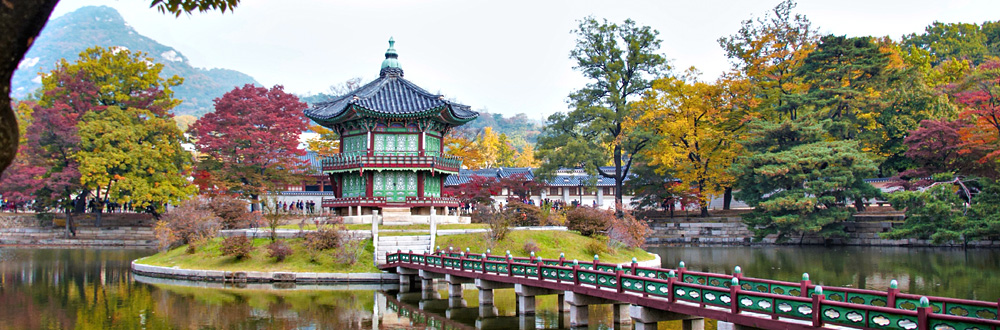
Gyeongbokgung Palace is a 40-hectare royal palace complex situated at the foot of Bugaksan in Seoul's Jongno district. Constructed in 1395 by King Taejo, the founder of the Joseon Dynasty, it served as the primary seat of government and royal residence until its destruction during the Imjin War in 1592. Rebuilt in 1867 under King Gojong, the site contains 7,700 chambers across key structures, including Gwanghwamun Gate, Geunjeongjeon Hall, and the Gyeonghoeru Pavilion. The grounds also house the National Palace Museum of Korea and the National Folk Museum of Korea.
Bukchon Hanok Village is an 113-hectare historic residential enclave in Seoul's Jongno district. Developed during the Joseon Dynasty (1392–1897) as an exclusive housing quarter for royal relatives and high-ranking government officials, the neighborhood contains over 900 traditional Korean structures. The architecture features timber post-and-beam frameworks, underfloor heating systems, and curved clay-tile roofs. Today, the preserved urban site functions as a mixed-use district containing private residences, cultural centers, traditional tea houses, and craft workshops.
N Seoul Tower is a 236.7-meter-tall radio transmission and observation tower located on the summit of Namsan Mountain in Seoul's Yongsan district. Designed by architect Jang Jong-ryul, construction began in December 1969 and was completed in 1975 to consolidate regional television and radio signals. The facility opened to the public in October 1980, adding public multi-level observation decks, transmission infrastructure, and digital entertainment halls. The site features the Namsan Cable Car transport link, public observation facilities, and extensive outdoor terrace areas.
Myeongdong is a primary commercial, retail, and tourism district in Seoul's Jung district. Originating as a residential zone during the Joseon Dynasty, the area developed into a major business quarter during the Japanese colonial period under the name Meijicho before adopting its current name in 1946. The district functions as a key economic hub, hosting major flagship retail stores, financial institutions, cosmetics outlets, and the historic 1898 Myeongdong Cathedral. Its pedestrianized central thoroughfares feature retail establishments alongside an extensive evening street food market.
Changdeokgung Palace is a royal palace complex situated in Seoul's Jongno district. Constructed in 1405 by King Taejong as a secondary seat of government, it served as the principal royal residence and government seat for 270 years during the Joseon Dynasty following the destruction of Gyeongbokgung in 1592. Designating a UNESCO World Heritage site, the property incorporates Donhwamun Gate, Injeongjeon Hall, and Huwon, a garden comprising 160 tree species, ponds, and pavilions. The architectural layout integrates structures directly with the surrounding topography.
Insadong is a historic cultural district covering a 500-meter central thoroughfare and adjoining alleys in Seoul's Jongno district. Originating during the Joseon Dynasty as a residential zone for royal court painters and scholars, the area transitioned into an art market during the Japanese colonial period as aristocrats sold antique personal belongings. Today, the pedestrian-friendly street contains roughly 40 percent of South Korea's antique stores, alongside traditional pottery workshops, calligraphy suppliers, hand-made paper dealers, and historic tea houses.
Dongdaemun Design Plaza is an urban development complex located in Seoul's Jung district. Designed by Zaha Hadid Architects in partnership with Samoo Architects & Engineers, the neo-futuristic structure features a seamless, curved aluminum facade constructed from 45,133 individual panels. The venue incorporates five main functional zones: Art Hall, Museum, Design Lab, Design Market, and Dongdaemun History & Culture Park. The complex serves as the primary hub for fashion and design industries, Seoul Fashion Week, major design exhibitions, and interactive retail facilities.
Hongdae is an urban university district situated around Hongik University. The neighborhood developed into a hub for indie culture, youth arts, and underground music during the 1990s. The area contains pedestrian street zones configured for live public busking, independent music venues, art ateliers, indie fashion boutiques, and theme cafes. Recognized as a core center for Seoul's nightlife and contemporary pop culture, the district hosts the weekly Hongdae Free Market alongside specialized urban street art murals, live performance clubs, and dynamic retail corridors.
The War Memorial of Korea is a military museum and memorial complex situated on the former headquarters site of the Army Headquarters. The venue displays over 33,000 military artifacts, with items exhibited across six indoor halls and an outdoor exhibition plaza. The collection encompasses historic combat equipment, armored vehicles, aircraft, naval vessels, and interactive historical documentation spanning military engagements to the Korean War. The central memorial hall contains black granite monuments engraved with the names of fallen personnel and United Nations coalition forces.
Noryangjin Fisheries Wholesale Market is a maritime produce market located in Seoul's Dongjak district. The market operates as one of South Korea's largest central wholesale seafood hubs, handling over 300 tons of aquatic products daily. The facility features a multi-story modern market hall housing wholesale auctions, retail stalls, and upper-level dining establishments where consumers purchase live seafood directly from vendors for immediate preparation. The market handles roughly 50 percent of the regional seafood volume distributed throughout the Seoul metropolitan area.