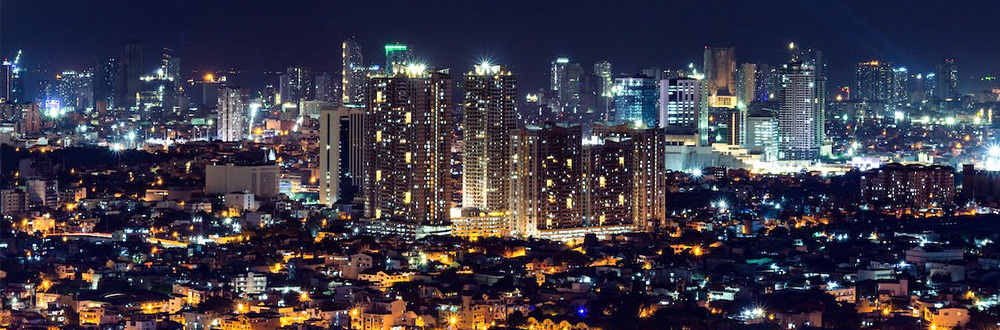
Manila is the capital of the Philippines, situated on the eastern shore of Manila Bay on Luzon Island. The highly urbanized city forms the historic core of Metro Manila, which encompasses 16 adjacent cities and municipalities. Founded in 1571 by Spanish conquistador Miguel López de Legazpi, Manila serves as the nation's political, economic, and transportation hub. The city features major maritime shipping infrastructure at the Port of Manila and connects regionally via Metro Rail Transit, Light Rail Transit, and Ninoy Aquino International Airport located 7 kilometers south of the city center.
Intramuros is a 0.67-square-kilometer historic walled district in central Manila, established by Spanish Governor-General Miguel López de Legazpi in 1571. Constructed using volcanic tuff blocks and surrounded by defensive moats, the urban fortress served as the political and religious seat of the Spanish East Indies. Key architectural landmarks include Fort Santiago, a citadel featuring dungeons that held political prisoners, including national hero José Rizal prior to his 1896 execution, and San Agustin Church, completed in 1607 as the Philippines' oldest standing stone church.
Rizal Park is a 58-hectare public park situated along Roxas Boulevard in central Manila, adjacent to the historic Intramuros district. The site gained historical significance as the execution location of national hero Dr. José Rizal on December 30, 1896. The park features the Rizal Monument, a 12.7-meter granite and bronze memorial housing Rizal's remains, guarded continuously by the Philippine Marine Corps. The complex encompasses the Central Lagoon, the Open-Air Auditorium, the Burnham Green, a Chinese Garden, a Japanese Garden, and the National Museum of Natural History.
The National Museum of the Philippines is a government-operated educational complex headquartered in the Historic East Triangle of Rizal Park. Established in 1901, the institution oversees primary central divisions: the National Museum of Fine Arts, housed in the 1926 Neo-Classical former Legislative Building; the National Museum of Anthropology; and the National Museum of Natural History. Notable collection highlights include Juan Luna's 1884 oil masterpiece Spoliarium, the 8th-to-10th-century Maitum anthropomorphic burial jars, and the pre-colonial Calatagan Ritual Pot.
Manila Ocean Park is an 8,000-square-meter oceanarium complex located behind the Quirino Grandstand at Rizal Park. The facility features a main attraction known as the Oceanarium, which holds 3,000 cubic meters of seawater and houses over 14,000 marine animals from 278 indigenous species. Key structural elements include a 25-meter, 220-degree curved acrylic underwater walkway tunnel, an interactive stingray touch pool, climate-controlled Humboldt penguin enclosures, and specialized performance arenas designed for educational marine mammal demonstrations.
Binondo is recognized as the world's oldest Chinatown. Established in 1594 by Spanish Governor-General Luis Pérez Dasmariñas as a settlement for converted Chinese immigrants, the enclave developed into a historic hub for commerce and finance. Key structural sites include the Minor Basilica of Saint Lorenzo Ruiz, which incorporates a octagonal granite bell tower combining Spanish Baroque and Chinese architecture. The district's commercial avenues, including Ongpin Street, serve as a center for gold trading, traditional Chinese medicine, and Hokkien-Filipino culinary establishments.
San Agustin Church is the oldest stone church in the Philippines, located within the historic walled city of Intramuros. Administered by the Order of Saint Augustine, the current structure was constructed between 1587 and 1607, replacing two earlier wooden iterations. Built with high-density volcanic tuff, the church survived major earthquakes in 1645, 1754, and 1880, as well as the 1945 Battle of Manila. Key features include a barrel-vaulted ceiling painted in 1875 by Italian artists Cesare Alberoni and Giovanni Dibella using trompe-l'œil techniques,
The Ayala Museum is a private art and history institution located in Metro Manila. Established in 1967 by the Ayala Foundation, the four-story facility showcases Philippine pre-colonial history, ethnographic art, and material culture. The primary collection features 60 handcrafted three-dimensional dioramas illustrating major historical events, alongside the Gold of Ancestors gallery, which displays over 1,000 pre-colonial gold artifacts dating from the 10th to the 16th centuries. The museum also houses trade ceramics, indigenous textiles, and rotating contemporary art.
The Baywalk is a 2-kilometer seaside promenade situated along Roxas Boulevard, running parallel to Manila Bay from the US Embassy to the Cultural Center of the Philippines. Designed as a pedestrian boulevard, the waterfront features coconut palm trees, open-air plazas, LED lighting installations, and dedicated seating overlooking the harbor. Serving as a public recreation space for walking and viewing sunsets, the site borders major maritime piers and connects adjacent commercial centers, open-air dining areas, and government landmarks along the Malate and Ermita district shorelines.
Divisoria Market is a major commercial district and wholesale shopping hub. Established during the Spanish colonial period as a non-taxed trade zone for non-Christian Chinese merchants, the market spans multiple indoor shopping centers and street-level open-air vendor stalls. Notable commercial complexes within the district include 168 Shopping Mall, 999 Shopping Mall, and Tutuban Center, built on the historic 1892 Manila-Dagupan railway terminal site. The district functions as the primary distribution nexus for low-cost textiles, garments, household goods, and imported merchandise.
Poblacion is a 1.03-square-kilometer administrative barangay and the historic center of Makati, situated along the southern bank of the Pasig River. Established in 1670 as the municipality's first settlement, the district spans 104 hectares and serves as Makati's heritage zone, housing the municipal hall and the 18th-century Saints Peter and Paul Parish Church. In recent decades, the area transitioned from a residential and red-light district into a commercial hub known for boutique hotels, independent dining establishments, craft breweries, speakeasies, and art galleries.