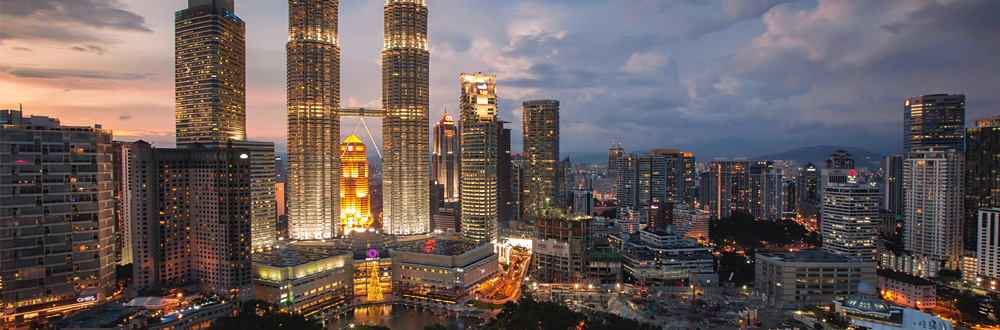
Kuala Lumpur is the capital of Malaysia, situated at the confluence of the Klang and Gombak rivers. Spanning 243 square kilometers, the federal territory serves as the country's cultural, financial, and economic center. The city's skyline is anchored by the Petronas Twin Towers, designed by César Pelli and completed in 1998, alongside the Merdeka 118. Transport infrastructure centers on KL Sentral, connecting mass rapid transit, light rail, and regional rail lines across the metropolis. The population reflects a multicultural demographic comprising Malay, Chinese, and Indian ethnicities.
The Petronas Twin Towers are 88-story identical skyscrapers standing at a total height of 451.9 meters. Designed by Argentine-American architect César Pelli and completed in 1996, the complex held the title of the world's tallest buildings from 1998 to 2004 and remains the world's tallest twin structures. The floor plan utilizes a Rub el Hizb geometric pattern, featuring high-strength reinforced concrete facades clad in glass and stainless steel. Key structural elements include a 58.4-meter double-decker skybridge spanning the 41st and 42nd floors and an 86th-floor observation deck.
The Batu Caves are a limestone hill containing a series of caves and cave temples located in Gombak, Selangor, 13 kilometers north of Kuala Lumpur. Formed roughly 400 million years ago, the site functions as a primary Hindu shrine dedicated to the deity Murugan. Access to the main Cathedral Cave requires ascending a steep flight of 272 concrete steps painted in bright colors. At the base of the staircase stands a 42.7-meter-tall gilded statue of Murugan, completed in 2006. The cavern complex serves as the focal point for the annual Thaipusam religious festival.
Merdeka Square is a historic public square located in central Kuala Lumpur near the confluence of the Klang and Gombak rivers. The site is best known as the location where the Union Flag was lowered and the Malayan flag was raised for the first time at midnight on August 31, 1957, marking Malaysia's independence from British rule. The square features a 95.2-meter flagpole—one of the tallest freestanding flagpoles in the world—and is bordered by landmark colonial structures, including the late 19th-century Mughal-eclectic Sultan Abdul Samad Building and the Royal Selangor Club.
The Kuala Lumpur City Gallery is an urban museum housed within a 120-year-old Neo-Moorish heritage building adjacent to Merdeka Square. Constructed in 1898 during the British colonial era as the Government Printing Office, the structure now serves as a central visitor center detailing the capital's architectural history. The facility features scale models of the city skyline, including a 40-by-50-foot interactive scale model of Kuala Lumpur's past, present, and proposed future developments. The exterior perimeter is marked by the original, iconic 2.5-meter-tall "I Love KL" structural sculpture.
Central Market is a historical landmark located in central Kuala Lumpur. Originally established in 1888 as a wet market, the current single-story structure was completed in 1937 in the Art Deco architectural style. Classified as a Heritage Site by the National Heritage Department, the building was renovated in the 1980s to transition from a produce market into a central hub for Malaysian arts, crafts, and cultural handiwork. The interior features zoned shop lots categorized by ethnic cultural influences, including Malay, Chinese, and Indian artisan stalls, alongside textiles and traditional batik work.
The Jamek Mosque is one of the oldest places of worship in Kuala Lumpur, situated at the exact confluence of the Klang and Gombak rivers. Designed by British architect Arthur Benison Hubback and officially opened in 1909, the complex incorporates Indo-Saracenic, Mughal, and Moorish architectural styles. The design features three onion-shaped domes flanked by two major brick-and-plaster minarets standing 26.8 meters high. Serving as the capital's main congregational mosque prior to the opening of the National Mosque in 1965, the structure is constructed primarily of red brick and marble.
The Islamic Arts Museum is Southeast Asia's largest Islamic art museum. The 30,000 square meter facility houses over 10,000 artifacts categorized across 12 permanent galleries, including Quranic manuscripts, Islamic architecture, weaponry, armor, ceramics, textiles, and jewelry. The building features turquoise-tiled domes crafted by Uzbek artisans and natural-light-filled exhibition spaces centered around an inverted dome structure. Notable collection highlights include large-scale architectural models of prominent global mosques and a restored 19th-century Ottoman Syrian Interior Room.
KL Bird Park is a 20.9-acre public aviary located within the Lake Gardens complex in central Kuala Lumpur. It ranks among the world's largest free-flight, walk-in aviaries, housing more than 3,000 birds representing roughly 200 distinct species. The facility is structured into four zones, with Zones 1 and 2 functioning as a continuous free-flight sanctuary beneath an expansive overhead netting enclosure. Prominent residents include Indian blue peacocks, rhinoceros hornbills, flamingoes, and various parrot species, alongside breeding facilities, feeding stations, and an outdoor amphitheater.
Thean Hou Temple is a six-tiered landmark temple situated on a hilltop along Persiaran Endah in Robson Heights. Constructed by the Hainanese community, the 4,750-square-meter complex combines elements of Buddhism, Taoism, and Confucianism, dedicated primarily to the sea goddess Mazu. The architecture features multi-tiered roofs, dragon-carved columns, decorative arches, and modern engineering. The main prayer hall houses three primary altars honoring Mazu, Guan Yin, and Shui Wei Sheng Liang, alongside a fortune-telling hall, courtyard, and medicinal herb garden.
The National Museum of Malaysia is the country's primary cultural history repository. Established in 1963, the two-story building incorporates traditional Malay palace architecture, featuring a central Rumah Gadang-style roof and exterior mosaic murals depicting national history. The interior comprises four main galleries: Prehistory, Malay Kingdoms, Colonial Era, and Modern Malaysia. The museum preserves extensive artifacts, including finds like the Dong Son bronze drums, royal regalia, traditional weapons, and outdoor displays of historical locomotives and traditional timber structures.