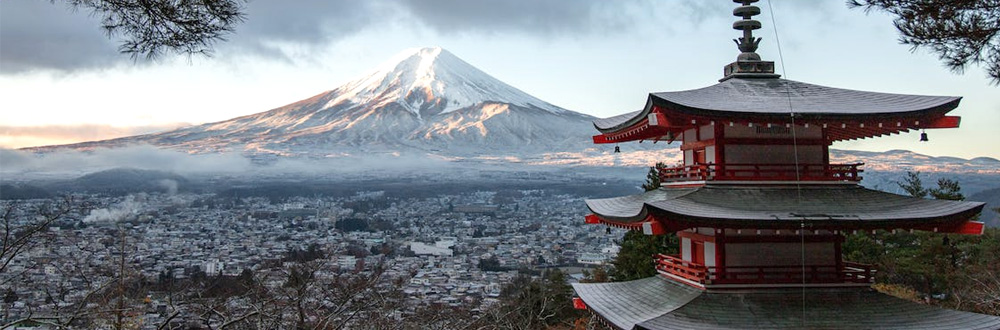
Japan is an archipelagic nation in East Asia comprising 6,852 islands, with four primary landmasses. Defined by mountainous terrain, the country contains active volcanic zones anchored by Mount Fuji at 3,776 meters. Urban centers range from Tokyo, the world's most populous metropolitan area, to historical capitals like Kyoto and Nara, preserving centuries of Shinto and Buddhist architecture. Japan's cultural and economic infrastructure integrates high-speed transit networks, regional culinary traditions, and preservation sites spanning feudal castles to UNESCO World Heritage forests.
Tokyo Tower is a communications and observation tower located in the Shiba-koen district of Minato. Designed by Tachū Naitō and completed in December 1958, the 332.9-meter lattice structure was modeled after the Eiffel Tower and painted international orange and white to comply with aviation safety laws. The tower features two observation platforms: the Main Deck at 150 meters and the Top Deck at 250 meters. At its base, the four-story FootTown commercial building houses retail outlets, dining venues, event spaces, and indoor digital amusement facilities.
The Kyoto Imperial Palace is the historic residence of Japan's Imperial Family, situated within the 65-hectare Kyoto Imperial Garden in Kamigyo Ward. Although the official imperial capital moved to Tokyo in 1869, the palace grounds preserve classical Heian-period architectural styles rebuilt following an 1855 reconstruction. The primary complex features the Shishinden, which houses the imperial thrones, alongside the Seiryoden and the Kogosho. Enclosed by earthen plaster walls, the site contains preserved timber structures, cypress-bark roofs, gravel courtyards, and classical Japanese gardens.
Mount Fuji is an active stratovolcano situated on Honshu, standing as Japan's highest peak at 3,776 meters. Located approximately 100 kilometers southwest of Tokyo, the snow-capped mountain is surrounded by the Fuji Five Lakes region and Hakone. The peak features an exceptionally symmetrical cone, a 500-meter-wide crater, and four primary hiking routes: Yoshida, Subashiri, Gotemba, and Fujinomiya. Designated a UNESCO World Heritage Site, the mountain serves as an enduring subject in classical Japanese art and a central pilgrimage site in Shinto traditions.
Hiroshima Peace Memorial Park is a 120,000-square-meter memorial park located in central Hiroshima. Established directly over the former commercial district destroyed by the atomic bomb on August 6, 1945, the grounds house the Atomic Bomb Dome, the remains of the Hiroshima Prefectural Industrial Promotion Hall preserved as a UNESCO World Heritage site. Designed by architect Kenzo Tange, the park contains the Cenotaph for the Victims, the Flame of Peace, the Children's Peace Monument, and the Hiroshima Peace Memorial Museum housing artifacts and documentation.
Himeji Castle is a hilltop feudal complex located in Himeji, Hyogo Prefecture. Constructed in 1333, the structure is widely known as the White Heron Castle due to its white plaster walls and soaring silhouette. Comprising 83 wooden buildings across three moats, the six-story main keep features advanced defensive architecture, including winding access paths, dropping chutes, loop-holed walls, and gated courtyards. Recognized as a UNESCO World Heritage site and a National Treasure of Japan, it stands as the largest and most pristine example of 17th-century Japanese castle architecture.
Osaka Castle is a landmark fortress located in Chuo Ward. Originally constructed in 1583 under the command of warlord Toyotomi Hideyoshi, the structure played a central role in the unification of Japan during the Azuchi-Momoyama period. The current five-tiered, eight-story main keep, rebuilt with reinforced concrete in 1931, houses a historical museum exhibiting samurai armor, weaponry, and historical documents. Enclosed by massive stone walls and outer moats, the surrounding two-square-kilometer park features preserved stone bastions, historic gates, and plum and cherry orchards.
The Great Buddha of Kamakura is a monumental bronze statue of Amida Buddha located on the grounds of Kotoku-in temple in Kamakura. Cast in 1252 during the Kamakura period, the icon stands at 13.35 meters tall and weighs approximately 121 metric tons. Originally housed inside a massive wooden temple hall, the surrounding structure was destroyed by a tsunami in 1498, leaving the statue exposed to the elements ever since. Designated a National Treasure of Japan, the figure features gilded trace remnants, traditional Buddhist iconography, and an interior accessible to visitors.
Nara Park is a 502-hectare public park established in 1880 at the foot of Mount Wakakusa. The grounds are famous for over 1,000 free-roaming sika deer, designated as natural monuments and historically regarded as sacred messengers in Shinto tradition. Spanning central Nara, the park encompasses major historical complexes including Todaiji, Kofukuji, and Kasuga Taisha. Lined with ancient timber structures, stone lanterns, and natural forest paths, the site features broad lawns, scenic ponds, and designated stalls selling specialized rice crackers to feed the resident deer.
Okinawa is Japan's southernmost province, encompassing 160 islands across the Ryukyu Archipelago. Historically governed as the independent Ryukyu Kingdom until 1879, the island chain retains a distinct cultural identity characterized by unique culinary practices, traditional music, and indigenous architecture. The sub-tropical region features extensive coral reef systems, diverse marine habitats, and historical sites such as Shuri Castle. As a premier maritime territory, the prefecture serves as a center for maritime parks, coastal biosphere reserves, and world-class scuba diving.
Shinjuku Gyoen National Garden is a 58.3-hectare park spanning the Shinjuku and Shibuya wards of Tokyo. Originally developed during the Edo period as a feudal lord's residence, the grounds were converted into an imperial garden in 1906 before opening to the public in 1949. The layout blends three distinct landscape styles: a formal French garden, an English landscape garden, and a traditional Japanese garden with quiet ponds and bridges. Housing over 1,000 cherry trees across 12 varieties alongside a large greenhouse, the park serves as an urban sanctuary for seasonal viewing.