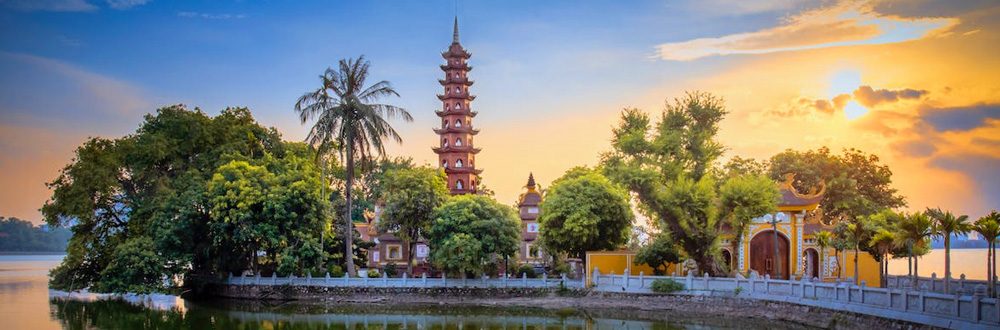
Hanoi is the capital of Vietnam, located in the northern region along the Red River Delta. The city features a urban core defined by French colonial architecture, tree-lined boulevards, and traditional tube houses. The historical nucleus contains the Old Quarter's 36 guild streets, the 11th-century Temple of Literature, and central water bodies such as Hoàn Kiếm Lake and West Lake. As a primary cultural and political hub, the municipality integrates ancient pagodas, national museums, and street-level culinary infrastructure within a dense metropolitan landscape.
Hoàn Kiếm Lake is a freshwater body occupying the historical center of Hanoi. Situated within Hoàn Kiếm District, the site serves as a geographic anchor dividing the Old Quarter and French Quarter. Located on Jade Island in the northern reach of the lake stands Ngọc Sơn Temple, a religious sanctuary dedicated to military commander Trần Hưng Đạo and Taoist scholar Wenchang Wang. Access to the island is provided by Húc Bridge, a wooden footbridge built in traditional vermilion lacquer. The complex houses Pen Tower and preserved specimens of the rare giant softshell turtle.
The Temple of Literature is a Confucian complex located in central Hanoi. Established in 1070 by Emperor Lý Thánh Tông, the site served as the imperial academy, functioning as the nation's first university to educate mandarins, scholars, and royal family members in Confucian philosophy. The layout consists of five walled courtyards, featuring Khê Văn Pavillion, the Well of Heavenly Clarity, and stone steles mounted on carved turtle pedestals recording royal graduates. The precinct remains an active cultural site representing historical Vietnamese education and Confucian scholarship.
The Old Quarter is a historical commercial district situated in Hoàn Kiếm District north of Hoàn Kiếm Lake. Originating in the 11th century as a network of craft guilds serving the Thăng Long Imperial Citadel, the area encompasses a grid of 36 traditional trade streets. Architectural features include narrow, multi-story tube houses with narrow street frontages designed to optimize commercial access and minimize property taxes. The precinct functions as a major urban market center, retaining specialized trade corridors alongside street-level food vendors and preserved merchant architecture.
Dong Xuan Market is a three-story commercial complex situated in the northern sector of Hanoi's Old Quarter, Hoàn Kiếm District. Originally constructed by the French colonial administration in 1889, it stands as the city's largest covered market. The structure features a distinctive five-arched Soviet-style façade rebuilt after a major 1994 fire. The interior operates as a major wholesale distribution center, housing hundreds of stalls selling textiles, clothing, bulk commodities, housewares, and fresh regional produce alongside a ground-floor street food hall serving local culinary staples.
The Ho Chi Minh Mausoleum is a granite monumental structure situated in Ba Đình Square. The edifice serves as the resting place of revolutionary leader Ho Chi Minh. The architectural design combines Socialist Realist forms modeled after Lenin's Mausoleum with traditional Vietnamese structural motifs, including a sloped terraced roof and portico pillars. The central air-conditioned glass chamber houses the preserved body of Ho Chi Minh under military guard. The surrounding complex encompasses grand parade grounds, formal gardens, and political administration buildings.
The Hanoi Opera House is a landmark venue situated in the French Quarter. Constructed between 1901 and 1911 by the French colonials, the edifice was modeled after the Palais Garnier in Paris. The architectural design showcases Neoclassical and French Renaissance elements, featuring a symmetrical façade, ionic columns, high-arched windows, and a mansard roof with slate tiles. The interior comprises an 870-seat auditorium with a vaulted ceiling and multi-tiered balconies. The venue continues to host national symphonies, ballet productions, and major state ceremonies.
St. Joseph's Cathedral is a Neo-Gothic Catholic church situated in the Hoàn Kiếm District of Hanoi, Vietnam. Constructed by the French colonial administration between 1884 and 1886, it serves as the cathedral of the Roman Catholic Archdiocese of Hanoi. Designed to resemble Notre-Dame de Paris, the structure features a brick and mortar exterior coated with granite slabs, twin bell towers rising to 31 meters, pointing arches, and stained glass windows imported from France. The interior houses a gilded timber altar in traditional Vietnamese decorative motifs.
Thăng Long Water Puppet Theatre is a cultural venue situated near the northeastern shore of Hoàn Kiếm Lake. The theatre showcases múa rối nước, a traditional folk art originating in the 11th century within the flooded rice paddies of the Red River Delta. Performances feature hand-carved, lacquer-coated wooden puppets manipulated over a water stage by puppeteers hidden behind a bamboo screen using underwater rods and strings. Shows depict Vietnamese folklore and rural legends, accompanied by a live traditional orchestra featuring wooden flutes, drums, gongs, and đàn bầu zithers.
The Vietnam Museum of Ethnology is a research and cultural institution situated in the Cầu Giấy District. The complex is dedicated to preserving and documenting the cultural heritage of Vietnam's 54 officially recognized ethnic groups. The facility comprises two main sections: the primary exhibit building housing thousands of artifacts, traditional costumes, musical instruments, and ethnographic photography, and an outdoor architectural garden featuring full-scale authentic dwellings built by native artisans, including a Bahnar communal stilt house, a Giarai tomb, and a Ede longhouse.
The One Pillar Pagoda is a historic Buddhist temple situated in the Ba Đình District, adjacent to the Ho Chi Minh Museum complex. Constructed in 1049 under Emperor Lý Thái Tông, the wooden structure was designed to resemble a blooming lotus blossom emerging from a square lily pond. Supported by a single stone pillar measuring 1.25 meters in diameter, the shrine houses an altar dedicated to the Bodhisattva Avalokiteshvara. Rebuilt in 1955 following its destruction during the First Indochina War, the site remains a central symbol of traditional Vietnamese religious architecture.