Bangkok is the capital and most populous city of Thailand, spanning 1,568 square kilometers in the Chao Phraya River delta. Established as a trading post during the Ayutthaya Kingdom, the settlement became the national capital in 1782 under King Rama I. Bangkok serves as Thailand's primary administrative, economic, and cultural center, housing a registered population exceeding 10.5 million people. Key urban infrastructure includes two international airports, an extensive elevated and underground rail system, and the historic Grand Palace complex, housing the sacred Wat Phra Kaew.
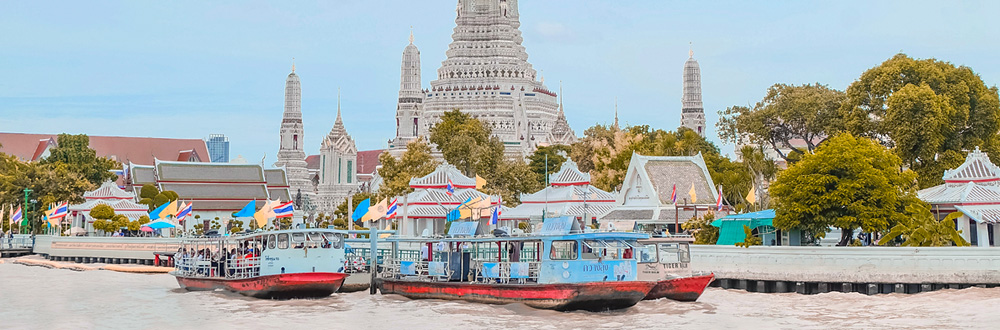
Wat Arun is a Buddhist temple located on the west bank of the Chao Phraya River in Bangkok's Yai district. Originating from the Ayutthaya period as Wat Makok, the site was renamed by King Taksin in 1768 to house the Emerald Buddha before undergoing major expansion under Kings Rama II and Rama III in the early 19th century. The central Khmer-style prang stands 82 meters tall and is encrusted with colorful Chinese porcelain tiles and seashell mosaics. Additional structures include four surrounding minor prang, an ordination hall, and ancient murals depicting the life of the Buddha.
The Grand Palace is a 218,400-square-meter walled complex located on the banks of the Chao Phraya River in Bangkok's Phra Nakhon district. Established in 1782 by King Rama I following the founding of the Chakri Dynasty, the site served as the official royal residence and administrative seat until 1925. The complex comprises the Outer Court, Central Court, Inner Court, and the temple precinct of Wat Phra Kaew. Wat Phra Kaew houses the 66-centimeter Phra Kaew Morakot statue, carved from green jasper and dressed in seasonal gold attire by the reigning Thai monarch.
Wat Phra Kaew is a sacred Buddhist precinct occupying 9.45 hectares within the Grand Palace grounds. Formally known as Wat Phra Si Rattana Satsadaram, the temple was founded in 1782 to house the Phra Kaew Morakot, a 66-centimeter-tall image carved from green jasper dating to 15th-century Northern Thailand. The main ordination hall features a gilded elevated throne, mother-of-pearl doors, and wall murals detailing the Ramakien epic. Surrounding structures include the Phra Mondop library, the gilded Phra Si Rattana Chedi, and a miniature replica of Angkor Wat.
Chatuchak Weekend Market is a 14-hectare market located in Bangkok's Chatuchak district. Established in 1942 and relocated to its present site in 1982, the complex contains over 15,000 stalls organized into 27 designated sections. The market draws an estimated 200,000 visitors each weekend. Managed by the State Railway of Thailand, the vendor sections are categorized by specific merchandise types, including regional handicrafts, Thai silk, vintage clothing, antiques, live plants, pets, home decor, and an extensive collection of open-air street food stalls surrounding the central clock tower.
Wat Pho is a 16-hectare first-class royal temple complex located on Sanam Chai Road in the Phra Nakhon district. Formally named Wat Phra Chetuphon Wimon Mangkhalaram Rajwaramahawihan, the site predates the founding of Bangkok and underwent major restoration under King Rama I in 1788. The main ordination hall houses the 46-meter-long, 15-meter-high gilded Reclining Buddha statue, featuring mother-of-pearl inlay on the soles of its feet. The grounds contain 91 chedi, four major royal stupas, and the Chetawan Traditional Medical School, serving as Thailand's historic center.
The Jim Thompson House is a museum complex located along the Saen Saeb Canal in Bangkok's Pathum Wan district. Established in 1959 by American entrepreneur Jim Thompson, the property consists of six historical 19th-century teakwood residential structures dismantled and transported from Ayutthaya and Bangkok's Ban Krua silk-weaving community. The main elevated house displays Thompson's extensive collection of Southeast Asian art, including 17th-century Thai Buddhist statues, Burmese wood carvings, Chinese blue-and-white porcelain, and traditional Benjarong ceramics.
Damnoen Saduak and Amphawa are canal-based trading hubs situated along the Mae Klong River basin. Established in 1866 under King Rama IV, Damnoen Saduak spans a 32-kilometer canal system in Ratchaburi Province and functions primarily as a morning tourist market operating long-tail wooden paddle boats. Amphawa is an afternoon and weekend evening market established in the mid-17th century. Both sites feature preserved wooden shophouse architecture, floating kitchens serving local river seafood and noodle dishes, and canal vessel networks integrated into rural transport.
Chinatown Bangkok is an ethnic commercial enclave covering roughly 2 square kilometers along Yaowarat Road and Charoen Krung Road in Bangkok's Samphanthawong district. Established in 1782 when King Rama I relocated the city's Chinese merchant population from the current Grand Palace site, the district serves as a major trade center for gold bullion, textiles, and Chinese herbal medicine. Key landmarks include Wat Traimit, which houses the 5.5-tonne solid-gold Phra Phuttha Maha Suwanna Patimakon Buddha statue, and the 1871 Wat Mangkon Kamalawat temple.
Khao San Road is a 410-meter-long street in Bangkok's Phra Nakhon district, located roughly 1 kilometer north of the Grand Palace. Constructed in 1892 during the reign of King Rama V, the road originally served as a major regional rice market. Transitioning into a global budget travel hub during the early 1980s, the thoroughfare features high-density backpacker hostels, tour agencies, street food vendors, and open-air bars. Located adjacent to the historic Banglamphu market area, Khao San Road remains a major tourist transit point connecting central Bangkok to regional bus and ferry networks.
The Chao Phraya River is a 372-kilometer waterway flowing south from the confluence of the Ping and Nan rivers in Nakhon Sawan to the Gulf of Thailand. Traversing central Bangkok, the river divides the metropolis into the Phra Nakhon and Thonburi administrative districts. Serving as a primary public transit corridor, the river carries over 50,000 commuters daily via the Chao Phraya Express Boat system and local cross-river ferries. Key infrastructure along its banks includes cargo ports, historic royal barge docks, and key landmarks such as Wat Arun, Wat Pho, and the Grand Palace.