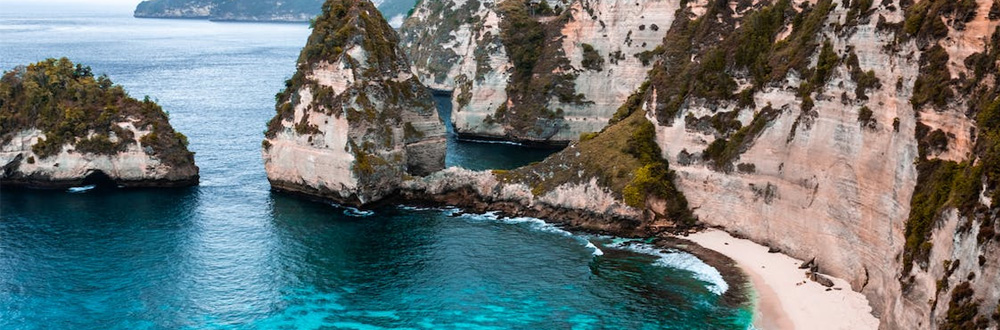
Asian coastal destinations encompass diverse tropical environments across the Indian Ocean, Andaman Sea, South China Sea, and Gulf of Thailand. Major beach corridors throughout Southeast Asia and India feature coral reef systems, limestone karst formations, and distinct regional marine ecosystems. Primary coastal activities include scuba diving, snorkeling, and maritime transit along shallow continental shelves. In addition to natural marine environments, major destination hubs maintain developed culinary infrastructure, historical cultural landmarks, and wellness tourism facilities.
Bali is a volcanic island in Indonesia situated at the western end of the Lesser Sunda Islands between Java and Lombok. The interior landscape is dominated by Mount Agung and features traditional Subak irrigation systems supporting terraced rice paddies. Coastal regions range from black sand beaches along the north to coral reefs and surf breaks around the southern Bukit Peninsula. As Indonesia's primary Hindu-majority province, the island contains thousands of temples, including Pura Besakih and Uluwatu, alongside artisan centers producing batik, woodcarvings, and performing arts.
Phuket is a landmass situated off the southwestern coast of Thailand in the Andaman Sea, connected to Phang Nga Province by the Sarasin Bridge. As Thailand's largest island, its western coastline features prominent granite headlands framing major beach bays, including Patong, Karon, and Kata. The interior contains remnant rainforest reserves like Khao Phra Thaeo and historical urban centers demonstrating Sino-Portuguese shophouse architecture in Old Phuket Town. Offshore waters serve as a departure hub for excursions to Phang Nga Bay's karst formations and the Phi Phi archipelago.
Langkawi is an archipelago located in the Andaman Sea, off the northwestern coast of mainland Malaysia near the Thai border. Designated as Southeast Asia's first UNESCO Global Geopark, the main island features ancient Cambrian Geoforest Park limestone formations, rainforest reserves, and coastal mangrove estuaries. Key geographical landmarks include Dayang Bunting (Pregnant Maiden Island) with its freshwater lake, the Langkawi Sky Bridge, and expansive beach corridors at Pantai Cenang and Tanjung Rhu. The surrounding waters host diverse fringing coral reefs and marine life.
Palawan is an archipelagic province situated between the South China and Sulu Sea. The main narrow landmass is bisected by a central mountain range and bounded by massive karst limestone formations. Notable geographic features include the Puerto Princesa Subterranean River National Park, a navigable underground river, alongside the protected marine reserves of El Nido's Bacuit Archipelago and Coron Bay's WWII Japanese shipwreck dive sites. The province encompasses diverse marine sanctuaries, mangrove forests, and coastal ecosystems supporting high marine biodiversity.
Koh Samui is an island situated in the Gulf of Thailand off the eastern coast of Surat Thani Province. As Thailand's second-largest island, its interior consists of dense mountainous rainforest dominated by Khao Pom peak, encircled by a coastal plain and expansive sand beaches including Chaweng and Lamai. Major cultural landmarks include Wat Phra Yai (Big Buddha) seated on a small rocky islet connected by a causeway. The island serves as the primary maritime gateway to the neighboring islands of Koh Phangan, Koh Tao, and the Ang Thong National Marine Park archipelago.
Goa is a coastal state located in western India along the Konkan region, bounded by the Arabian Sea to the west and the Western Ghats mountain range to the east. The coastline features distinct beach sectors, with northern stretches known for active shorelines and southern zones characterized by quiet coves and palm-lined bays. Having functioned as the capital of Portuguese India for over four centuries, the state retains distinct Indo-Portuguese heritage, visible in the UNESCO World Heritage churches of Old Goa, colonial plantation estates, and regional Goan cuisine.
Havelock Island, officially known as Swaraj Dweep, is the largest island within the Ritchie's Archipelago in the Andaman Sea, administered as part of India's Andaman and Nicobar Islands. Positioned east of Great Andaman, the island is defined by dense tropical evergreen forests bordered by white sand beaches, notably Radhanagar Beach and Elephant Beach. The surrounding marine waters harbor extensive fringing coral reefs, underwater drop-offs, and high marine biodiversity, establishing the island as a primary regional destination for scuba diving, snorkeling, and sea kayaking expeditions.
Koh Rong is the second-largest island of Cambodia, situated in the Gulf of Thailand off the coast of Sihanoukville Province. The island features an undeveloped interior covered by dense jungle, surrounded by dozens of white sand beaches across its perimeter, including Sok San Beach. The surrounding coastal waters sustain fringing coral reefs, seagrass beds, and bioluminescent plankton populations visible at night. Infrastructure remains largely decentralized, with local transport relying primarily on longtail boats, walking trails, and small jetty points connecting coastal fishing villages.
The Gili Islands are an archipelago of three small coral islands, Gili Trawangan, Gili Meno, and Gili Air, located just off the northwest coast of Lombok, Indonesia. Rising barely above sea level, the low-lying islands are entirely surrounded by shallow fringing coral reefs and sand flats known for resident sea turtle populations. Motorized vehicles are prohibited across all three islands, with local transport restricted to bicycles and horse-drawn carts (cidomo). The surrounding waters serve as a major hub for diving certification and snorkeling excursions within the Coral Triangle.
Nha Trang is a coastal city and capital of Khánh Hòa Province in south-central Vietnam, situated along Nha Trang Bay. The coastline is defined by a crescent beach backed by a city promenade, with offshore islands protecting the bay's marine environment. The surrounding waters encompass the Hòn Mun Marine Protected Area, known for coral reef biodiversity and diving spots. Historical landmarks within the city include the 8th-century Po Nagar Cham Towers, an ancient Hindu sanctuary built by the Champa Kingdom, and the Long Sơn Pagoda featuring a large seated Buddha statue.