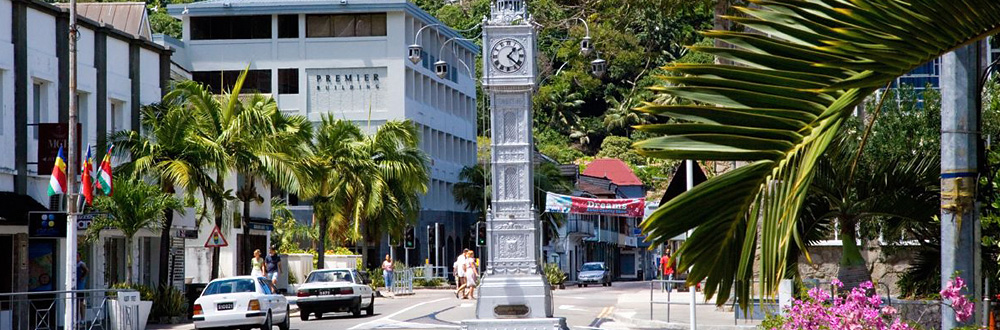
Established as the seat of British colonial administration in 1778, Victoria functions as the national capital of the Seychelles. The municipal port occupies a coastal basin bounded by the Indian Ocean and surrounding granite peaks, serving as the archipelago's core administrative hub. Structural landmarks include the 1903 silver-painted Clock Tower modelled after a London prototype, and the Sir Selwyn Selwyn-Clarke Market. Providing deep-water berths for international cargo and ferry transport, the municipality anchors national commerce, government operations, and regional tourism infrastructure.
Erected in 1903 in downtown Victoria, the Clock Tower serves as a prominent colonial-era monument on Mahé Island. Commissioned to commemorate Queen Victoria following her death in 1901, the cast-iron structure was manufactured in London by Gillett & Johnston and modeled after the Little Ben clock tower near Vauxhall Bridge. Standing at a height of approximately 25 feet, the green-painted structure features four clock faces set atop an octagonal base and stepped plinth. Positioned at a central traffic intersection, the landmark functions as a historic civic focal point.
Traversing the eastern slopes of the Morne Seychellois National Park on Mahé Island, the Copolia Trail extends approximately 1.4 kilometers with a vertical ascent of 170 meters. The designated hiking route navigates dense granitic forest terrain characterized by endemic flora species. Ascending to an elevation of 497 meters, the path terminates on an exposed granite plateau providing panoramic views of Victoria, St. Anne Marine National Park, and the Indian Ocean coastline. Wooden boardwalks and handrails protect sensitive ecological zones while accommodating pedestrian foot traffic.
Established in 1840, the Market serves as the primary trading hub on Market Street in central Victoria. Named after former British Governor Sir Percy Selwyn-Clarke, the two-story covered architectural complex features open-air perimeter stalls and a central atrium floor. The ground level functions as a regional commercial supply center for fresh fish, vegetables, local spices, and tropical fruits. Upper-level galleries accommodate boutique vendors selling local textiles, wood carvings, and souvenir crafts, anchoring domestic food distribution and small-scale urban commerce on Mahé Island.
Founded in 1901 by French botanist Antoine-Abel Rignaud, the Gardens encompass approximately fifteen acres in the Mont Fleuri suburb south of Victoria. The historical grounds contain an extensive collection of mature tropical flora, including over fifty varieties of palm trees and the endemic Coco de Mer palms. Dedicated enclosures house a population of free-roaming Aldabra giant tortoises (Aldabrochelys gigantea), alongside specialized spice and orchid gardens. The landscaped site serves as a primary horticultural research facility, public park, and conservation center for native plants.
The Natural History Museum operates as the national repository for Seychellois scientific and cultural heritage. The facility organizes displays across two primary galleries focusing on regional biodiversity, marine ecosystems, and geological evolution. Permanent collections feature endemic fauna specimens, including giant tortoise osteology, rare avian taxidermy, and marine invertebrate displays from surrounding coral reefs. Additional cultural exhibits present early settlement artifacts, historical navigation charts, and traditional artisanal crafts documenting the archipelago's human history.
Occupying the former Supreme Court building, the Victoria National Museum of History documents the socio-political evolution of the archipelago. Galleries chart the human record from 18th-century French exploration and British colonial rule through national independence in 1976. Archival collections feature historical nautical maps, governance documents, colonial weaponry, and photographic records chronicling local demographics. The institution provides primary documentation on Indian Ocean maritime trade routes, Creole cultural development, and Seychellois constitutional history.
Consecrated in 1859, St. Paul's Cathedral operates as the principal Anglican cathedral of the Diocese of Seychelles. The original structural framework underwent extensive architectural reconstruction, reopening in 2004 with a modernized tent-shaped roof design engineered to withstand regional tropical weather. The interior houses the bishop's throne, traditional wooden chancel furnishings, and commemorative plaques documenting early Anglican missionary history. The ecclesiastical site functions as the administrative headquarters for the Church of the Province of the Indian Ocean.
Situated northwest of Victoria, Beau Vallon Beach spans approximately two kilometers along the northwestern bay of Mahé Island. Characterized by a broad crescent of fine granitic sand and shallow, reef-protected waters, the bay lacks strong longshore currents, facilitating year-round maritime access. The coastal zone supports water sports operations, including motorized personal watercraft, windsurfing, and scuba diving. Anchored by major hotel developments and commercial dining establishments, the beach serves as a primary hub for municipal tourism.
The Seychelles National Library operates within downtown Victoria as the primary institutional archive for published and manuscript materials. The library maintains comprehensive collections documenting Seychellois history, Creole literature, and regional legislative records alongside international reference volumes. Specialized archives house historical maps, administrative papers, and periodical runs supporting academic research and cultural preservation. The facility functions under national oversight to provide public access to bibliographic resources, rare texts, and educational programs.
Constructed in 1855 in central Victoria, Kenwyn House Gallery represents a preserved example of 19th-century French Creole residential architecture. Built originally as a home for Eastern Telegraph Company engineers, the two-story wooden structure features steep metal hip roofing, expansive wrap-around verandas, and ornamental fretwork trim. The estate served historically as a corporate residence and luxury retail gallery before conversion into a heritage conservation site. The landmark anchors urban architectural preservation efforts, hosting art exhibitions and cultural displays.