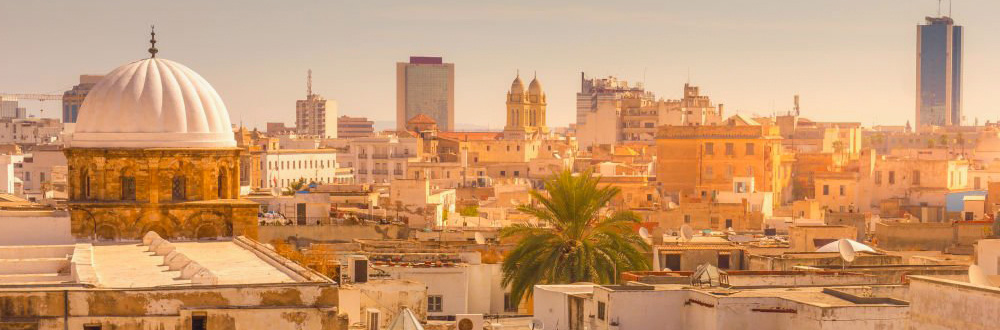
Tunis functions as the national capital and primary economic center of the Tunisian Republic. The municipality encompasses a dense metropolitan area incorporating administrative ministries, financial institutions, and manufacturing headquarters. Urban geography spans the historic walled medina, the French colonial Haussmann-style Ville Nouvelle, and modern commercial districts extending toward the Mediterranean coast. The municipal transport network integrates the Port of La Goulette, Tunis-Carthage International Airport, and light rail transit lines serving the urban population.
Enclosed by stone ramparts constructed during the Aghlabid and Hafsid dynasties, the Medina of Tunis encompasses a 270-hectare urban fabric designated as a UNESCO World Heritage site. The historic core features a network of covered souks, residential quarters, madrasas, and palaces reflecting Islamic and Ottoman architecture. Major monuments within the district include the 9th-century Zitouna Mosque, the Dar El Bach Palace, and historic mausoleums. Operating as a commercial and residential zone, the medina houses artisan guilds, textile merchants, and spice traders.
Founded in 732 AD at the geometric center of the medina, the Zitouna Mosque represents the oldest religious complex in Tunis, occupying 5,000 square meters. Reconstructed under Aghlabid rule in the 9th century, the monument features a hypostyle prayer hall supported by 160 antique marble columns retrieved from ancient Carthage. The central courtyard is enclosed by horseshoe-arched arcades, anchored by a 43-meter square minaret completed in 1894. Functioning historically as an Islamic university and scholarly archive, the mosque serves as the primary congregational sanctuary.
Constructed in the late 12th century, the Koutoubia Mosque stands as the largest religious structure in Marrakesh. The architectural complex features a stern stone hypostyle prayer hall complemented by a towering 77-meter square minaret crafted from sandstone and embellished with distinct ceramic tile bands and pointed arches. The vertical structure dominates the southwestern sector of the medina near Jemaa el-Fnaa. Functioning continuously as a primary congregational mosque, the facility preserves foundational Almohad structural engineering and decorative masonry traditions.
Commissioned by Sultan Ahmad al-Mansur in the late 16th century, the Saadian Tombs function as an royal necropolis adjacent to the Kasbah Mosque. The complex comprises sixty members of the Saadian dynasty interred within two primary mausoleums surrounded by enclosed garden courtyards. The central structure incorporates the Chamber of the Twelve Columns, featuring Italian Carrara marble pillars, gilded honeycomb muqarnas, and glazed zellij tilework. Sealed off under Alaouite ruler Moulay Ismail, the site remained structurally preserved until aerial mapping revealed its position in 1917.
Madrasa Ben Youssef operated as the largest Islamic college in North Africa, accommodating up to 900 students. The central courtyard displays traditional Moroccan Islamic architecture, incorporating carved cedarwood lintels, stucco Arabesques, and geometric zellij tile mosaics surrounding a central marble ablution basin. Surrounding the upper perimeter are 130 student dormitory cells arranged across two levels. Situated in the northern sector of the Marrakesh medina, the educational complex now functions as a historical museum and architectural landmark.
Designed over forty years by French Orientalist painter Jacques Majorelle, Jardin Majorelle spans two acres of botanical displays in the Ville Nouvelle district of Marrakesh. The property features an extensive collection of global flora, including desert cacti, bamboo groves, and aquatic lily ponds surrounding an Art Deco villa painted in cobalt blue—a patented hue known as Majorelle Blue. Acquired and restored by fashion designers Yves Saint Laurent and Pierre Bergé in 1980, the compound incorporates the Pierre Bergé Museum of Berber Arts within the painter's former studio.
Housed within the late 19th-century Dar Menebhi Palace, the Museum of Marrakech exhibits historic and contemporary Moroccan art within an architectural setting defined by central courtyards, carved plasterwork, and massive brass chandeliers. Constructed for royal minister Mehdi Mnebhi, the palatial residence features traditional Andalusian-Moroccan design elements, including extensive zellij tilework and cedarwood ceilings. The permanent galleries preserve historical weapons, Berber pottery, Moroccan carpets, contemporary paintings, and Jewish ritual artifacts.
Dating from the Saadian dynasty in the mid-16th century and reconstructed in the mid-19th century, Le Jardin Secret occupies a major palatial grounds in the Mouassine quarter of the Marrakesh medina. Restored between 2008 and 2016, the estate comprises two distinct outdoor spaces: an exotic garden showcasing arid global species and a formal Islamic garden restored to its historic geometric quadrangle layout. The site retains traditional hydraulic engineering, utilizing underground channels to deliver Atlas Mountain runoff into marble basins, fountains, and central irrigation networks.
Maison de la Photographie maintains an extensive archival collection of over 10,000 vintage photographs, glass plate negatives, and early documentary films illustrating Moroccan social history. The permanent exhibition spaces display ethnographic prints, colonial documentation, and rural landscape studies compiled from early European travelers and local photographers. Situated within the historic medina, the institution operates a specialized research library, screening rooms for historical film footage, and an upper terrace overlooking the city and the Atlas Mountains.
Constructed in the late 19th century, the Dar Si Said Museum operates as the National Museum of Weaving and Carpets in Marrakesh. The palatial complex reflects late Alaouite architecture, characterized by painted domed ceilings, intricate stucco work, and geometric zellij tilework centered around two expansive courtyards. The institution preserves a collection of Moroccan decorative arts, including historic Berber rugs, carved cedar woodwork, traditional leather items, and an 11th-century Andalusian marble basin. Situated near Bahia Palace, the site documents regional craft traditions.