Positioned at the foot of the High Atlas Mountains, Marrakesh functions as a principal economic, cultural, and historic urban center. Founded in 1070 AD, the city retains a UNESCO-listed medieval fortified medina containing dense marketplaces, caravanserais, and monumental stone archways. Major structural landmarks include the 12th-century Koutoubia Mosque minaret, the 19th-century Bahia Palace complex, and the Saadian Tombs enclave. Serving as a major transportation nexus, the municipality provides extensive road, rail, and international air access for North African regional commerce.
Serving as the primary commercial and public gathering space within Marrakesh's medina, Jemaa el-Fnaa dates to the city's 11th-century foundation under the Almoravid Dynasty. The urban plaza connects major souk trading corridors with key historical arteries. Daily operations transition from merchandise trading, orange juice concessions, and traditional performances into a dense evening food market. As a UNESCO Intangible Cultural Heritage space, the triangular public square provides essential open space infrastructure, urban economic access, and cultural heritage preservation.
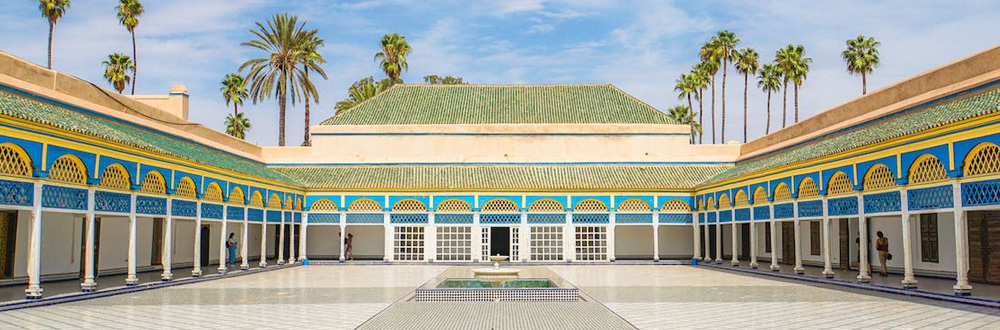
Constructed in two phases between 1859 and 1900 for Grand Viziers Si Musa and Ba Ahmed, Bahia Palace spans an eight-hectare footprint in southern Marrakesh. The architectural complex encompasses 160 rooms arranged around interior courtyards, marble plazas, and enclosed citrus groves. Structural highlights showcase classical Moroccan decorative craft, featuring zellij tilework, carved stucco, painted cedarwood ceilings, and stained-glass windows. Operating as a historical museum and public monument, the estate illustrates late 19th-century Alawite residential architecture.
Erected during the Almohad Caliphate under Sultan Abd al-Mu'min around 1158 AD, Koutoubia stands as the largest active mosque in Marrakesh. The monumental sanctuary features a 253-foot sandstone minaret crowned with keystone arches, copper spires, and ceramic tile banding. The building's interior layout encompasses 17 parallel naves supported by over 100 structural pillars around a central courtyard. Situated adjacent to Jemaa el-Fnaa and surrounded by public gardens, the complex serves as a primary architectural model for Almohad design and western Islamic engineering.
Commissioned by Sultan Ahmad al-Mansur in the late 16th century, the Saadian Tombs serve as a royal necropolis adjacent to the Kasbah Mosque. The sealed funerary complex contains over 200 burials of Saadian dynasty rulers and family members set across two primary mausoleums and surrounding garden enclosures. The main chamber, known as the Chamber of the Twelve Columns, features imported Italian Carrara marble pillars, honeycomb muqarnas ceilings, and elaborate zellij tilework. The site acts as a key structural showcase of 16th-century Saadian architecture.
Founded by Marinid Sultan Abu al-Hasan in the 14th century and extensively rebuilt by Saadian Sultan Abdallah al-Ghalib in 1564, the Ben Youssef Madrasa stands as the largest historic Islamic college in Morocco. The educational complex housed up to 900 students across 130 upper-level dormitory cells. A central marble courtyard features a rectangular water basin framed by cedarwood lintels, carved stucco, and geometric zellij tilework. Positioned north of the medina's central markets, the facility provides significant structural evidence of 16th-century Saadian craftsmanship.
Designed over forty years by French Orientalist painter Jacques Majorelle starting in 1923, Jardin Majorelle spans two acres in Marrakesh's modern Gueliz district. Acquired and restored by Yves Saint Laurent and Pierre Bergé in 1980, the botanical complex contains over 300 plant species, including extensive cacti collections, bamboo groves, and aquatic lily basins. The property centers around an Art Deco studio painted in cobalt blue, housing the Pierre Bergé Museum of Berber Arts. The landscaped grounds serve as a major horticultural repository, architectural monument, and cultural museum.
Housed within the late 19th-century Dar Menebhi Palace near the Ben Youssef Madrasa, the Marrakech Museum operates as a cultural institution in the historic medina. Constructed by Mehdi Mnebhi, Defense Minister under Sultan Abdelaziz, the 2,100-square-meter estate features Andalusian architectural elements, centered around a covered courtyard containing a large brass chandelier, marble fountains, and zellij tilework. The museum's permanent collection displays Moroccan artifacts, including regional pottery, Berber jewelry, traditional weapons, copperware, and historical coins.
Le Jardin Secret is an historic palace complex originating during the Saadian Dynasty in the mid-16th century. The half-hectare property underwent extensive structural restoration before opening to the public in 2016. The grounds are divided into two distinct open-air zones: an Exotic Garden showcasing global botanical species and a classical Islamic Garden structured around traditional four-quadrant geometric layouts. Utilizing restored historic hydraulic networks fed by High Atlas water channels, the complex illustrates palatial architecture and traditional Islamic garden design.
The Maison de la Photographie occupies a restored three-story fondouk dating to the early 20th century. The private archive contains roughly 10,000 original prints, glass plates, postcards, and early documentary films. Exhibitions rotate across floor galleries, highlighting ethnographic portraits, Atlas Mountain landscapes, and urban architectural developments captured by pioneer photographers like Felix and Gabriel Veyre. An upper roof terrace overlooks the medina skyline toward the High Atlas range, anchoring the institution as an essential visual repository for North African photography.
The Dar Si Said Museum operates as Marrakesh's National Museum of Weaving and Carpets. The two-story architectural estate features carved cedarwood ceilings, zellij tilework, and a central courtyard lined with orange trees and marble basins. Exhibition spaces highlight historic Moroccan craft traditions, displaying regional Berber carpets, brasswork, carved weaponry, leathergoods, and traditional jewelry. Located near Bahia Palace in the southern medina, the facility serves as a primary repository for North African material culture and historic architectural preservation.