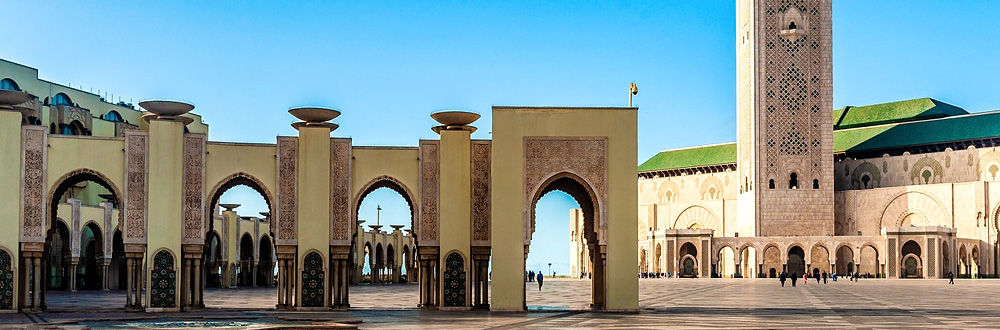
Casablanca functions as the primary economic and industrial capital of the Kingdom of Morocco. The municipality covers a sprawling metropolitan area, anchoring national banking, manufacturing, and maritime trade. Major landmarks include the monumental Hassan II Mosque completed in 1993 with a 210-meter minaret, the historic Habous quarter, and the Art Deco commercial core developed during the French protectorate. The urban port handles extensive international cargo freight, supporting the national financial sector, corporate headquarters, and commercial transport infrastructure.
Completed in 1993 along Boulevard Sidi Mohamed Ben Abdellah, the Hassan II Mosque represents a monumental religious structure designed by French architect Michel Pinseau. Situated on a rocky promontory projecting into the Atlantic Ocean, the structural complex incorporates an automated retractable roof, heated floors, and a 210-meter minaret equipped with a laser system directed toward Mecca. The main prayer hall accommodates up to 25,000 indoor worshipers across a 20,000-square-meter footprint, featuring hand-carved cedar timber, zellij tilework, and marble masonry.
Enclosed by 18th-century defensive stone walls, the Old City occupies a historic sector between the modern port and Boulevard Félix Houphouët-Boigny. Reconstructed following the 1755 earthquake under Sultan Sidi Mohammed ben Abdallah, the district covers a dense, irregular urban grid of narrow residential passages and commercial alleyways. The quarter incorporates historic structures such as the Bab El-Marsa gate and the Sqala fortification. Serving as an active municipal commercial zone, the neighborhood houses artisan workshops, produce markets, and traditional vendors.
La Corniche serves as Casablanca's primary coastal boulevard and recreational artery. Developed during the 20th century, the multi-kilometer paved promenade links the Hassan II Mosque precinct with the western beach quarters and El Hank lighthouse. The boulevard infrastructure encompasses wide pedestrian walkways, landscaped public plazas, public beach access points, and road connections. Functioning as a major commercial and leisure corridor, the strip accommodates high-density hospitality venues, seafood dining establishments, private beach clubs, and urban traffic.
Opened in December 2011 in the Ain Diab district, Morocco Mall encompasses 250,000 square meters of gross floor area in southwestern Casablanca. The three-story retail complex contains over 600 commercial storefronts, a traditional artisanal souk, and an IMAX 3D cinema enclosure. The central atrium features the Aquadream, a 1,000,000-liter cylindrical aquarium containing hundreds of marine species. Functioning as a major regional retail hub, the commercial facility integrates extensive parking facilities, international retail chains, food courts, and indoor leisure venues.
Centered around a monumental musical fountain, Mohammed V Square functions as the administrative and civic plaza of downtown Casablanca. Designed during the French protectorate, the urban space is enclosed by Neo-Classical and Moorish Revival public architecture, including the Wilaya municipal building, the Palace of Justice, and the French Consulate. The open pedestrian layout features manicured lawns, palm plantings, and formal stone paving. Serving as a primary municipal gathering hub, the plaza connects major urban thoroughfares and anchors the administrative core.
Constructed in 1934, the Villa of Arts operates as a contemporary cultural center managed by the ONA Foundation. Housed within a preserved Art Deco residential building, the museum covers two exhibition floors dedicated to contemporary Moroccan and international visual arts. The facility organizes rotating exhibitions of paintings, sculptures, and photography alongside cultural seminars, literary events, and educational workshops. Anchoring Casablanca's modern art infrastructure, the institution preserves regional architectural heritage while promoting contemporary creative expression.
Integrated into the 18th-century Portuguese bastion along Boulevard des Almohades, La Sqala operates as a traditional Moroccan restaurant opposite Casablanca's port. Reconstructed under Sultan Sidi Mohammed ben Abdallah in 1769, the fortified stone complex retains its historic ramparts, brass cannons, and an enclosed courtyard garden. The venue specializes in regional culinary heritage, serving tagines, couscous, pastillas, and traditional breakfast items. Serving as both a dining establishment and an architectural heritage site, the facility preserves maritime defense infrastructure.
Constructed during the French protectorate in the 1920s and 1930s, the Habous Quarter occupies a southeastern district of Casablanca. Designed as a new municipal administrative and residential zone, the neighborhood merges traditional Moroccan urban layouts with European architectural planning principles. The district encompasses arcaded wide boulevards, public squares, artisan marketplaces, and civic buildings. Functioning as a major commercial and cultural center, the quarter houses specialist bookshops, traditional sweet bakeries, and textile merchants.
Opened in 2004, Rick's Café occupies a restored 1930s traditional Moroccan mansion built against the Old Medina walls. Conceived by former American diplomat Kathy Kriger, the venue reproduces the architectural aesthetic of the fictional establishment depicted in the 1942 motion picture Casablanca. The interior design incorporates central courtyard arcades, carved wood furnishings, brass chandeliers, and an authentic Pleyel piano. Operating as a high-end restaurant and lounge bar, the commercial venue serves international seafood and traditional Moroccan dishes.
Occupying a secured compound, the Royal Palace functions as an official royal residence for the King of Morocco. Designed by architects Habak and Zevaco during the mid-20th century, the complex incorporates formal gardens, ceremonial courtyards, and monumental brass entry gates crafted by traditional metalworkers. The perimeter is guarded continuously by the Royal Moroccan Guard, restricting public access to the grounds. The exterior plazas and surrounding landscaped avenues host state functions and architectural displays reflecting traditional Moroccan design principles.