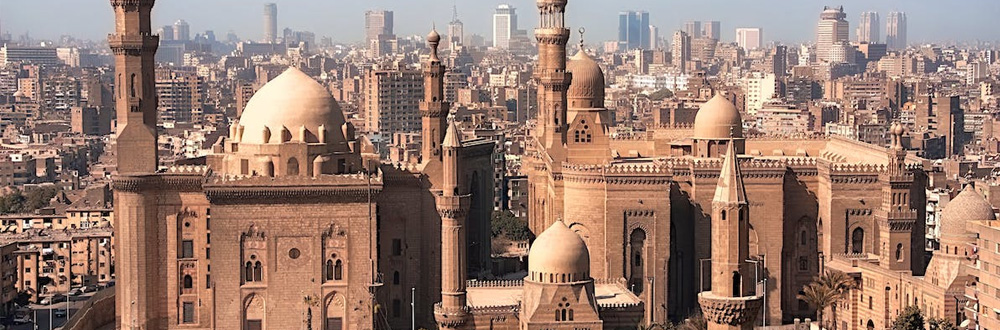
Cairo functions as the primary gateway to Egypt, situated immediately north of the Nile Delta. Visitors navigate districts like Tahrir Square and Zamalek to access art galleries, traditional restaurants, and historic riverboat terminals. Short drives lead directly to Old Cairo's Coptic churches and Islamic citadels, while highway corridors link downtown hotels to West Bank archaeological zones. Complete with international hotels, metro transit systems, and dense market streets, the capital offers a centralized, highly accessible base for architectural study, museum exploration, and regional commerce.
Constructed during Egypt's Fourth Dynasty around 2500 BC, the Giza Necropolis anchors a limestone plateau nine miles west of Cairo. The complex contains three major royal pyramid tombs erected for the pharaohs Khufu, Khafre, and Menkaure. The Great Pyramid of Khufu originally reached a height of 481 feet, utilizing roughly 2.3 million megalithic limestone blocks over a 13-acre base. Flanked by the Great Sphinx, causeways, and satellite mastaba tombs, the UNESCO site represents ancient stone engineering, astronomical alignment, and Fourth Dynasty monumental architecture.
Carved from the limestone bedrock of the Giza Plateau around 2500 BC, the Great Sphinx of Giza represents the oldest known monumental sculpture in Egypt. Attributed to the reign of Pharaoh Khafre, the monolithic monument measures 240 feet in length and 66 feet in height, depicting a mythical creature with a lion's body and a royal human head. Aligned along the eastern axis of the Khafre pyramid causeway, the sculpture served a symbolic protective function within the royal mortuary complex, demonstrating Fourth Dynasty stone masonry, iconographic traditions, and ancient site planning.
Established in 1902 in Cairo's Tahrir Square, The Egyptian Museum occupies a two-story neoclassical building designed by French architect Marcel Dourgnon. The institution houses an extensive inventory of over 120,000 pharaonic antiquities, including Old Kingdom statuary, Greco-Roman papyri, sarcophagi, and the Narmer Palette. Ground floor galleries organize monumental stone sculptures chronologically from the Predynastic through the Roman periods, while upper levels retain major funerary collections, coins, and royal mummification equipment.
The Citadel occupies a strategic limestone promontory on Mokattam Hill above Cairo. The medieval fortification served as the seat of Egyptian government for nearly 700 years, featuring defensive curtain walls, towers, and deep water wells. Within the complex stand major architectural monuments, including the 19th-century Ottoman Mosque of Muhammad Ali, the Mosque of al-Nasir Muhammad, and the National Military Museum. Positioned above the capital's historic core, the site provides extensive visual oversight and critical structural evidence of Islamic military engineering.
Al-Azhar Mosque anchors historic Islamic Cairo as the capital's premier religious and educational complex. The site expanded from a single prayer hall into a renowned center of Islamic learning, formalizing university operations by 988 AD. Architectural additions across Fatimid, Mamluk, and Ottoman eras created a central marble courtyard flanked by five distinct minarets, intricate stuccowork, and expansive porticoed halls. Functioning as the administrative headquarters for Al-Azhar University, the sanctuary serves as a principal global authority on Sunni Islamic jurisprudence and theology.
Established as a commercial center in 1382, Khan el-Khalili forms the primary historic bazaar district in Islamic Cairo. The open-air commercial complex features narrow vaulted alleyways, stone caravanserais, and Mamluk-style arched portals housing traditional artisan workshops. Merchants sell copperware, silver jewelry, leather goods, spices, and stained-glass lamps across distinct trade quarters. Adjacent to the Al-Hussein Mosque and historic coffeehouses like El Fishawy, the market district serves as a central hub for urban commerce, craft production, and medieval architectural study.
Enclosed within the Roman-era Fortress of Babylon in Old Cairo, Coptic Cairo serves as the historical center of Christian antiquities and religious architecture in Egypt. The pedestrian enclave contains major ecclesiastic sites, including the 3rd-century Saint Virgin Mary's Coptic Orthodox Church, the Church of St. Sergius and Bacchus, and the Ben Ezra Synagogue. The Coptic Museum anchors the precinct, displaying roughly 16,000 artifacts encompassing Christian textiles, illuminated manuscripts, stone carvings, and woodwork.
Cairo Tower stands on Gezira Island in central Cairo as the city's primary modern architectural observation post. Completed in 1961, the 614-foot concrete lattice structure features an openwork design mimicking a pharaonic lotus plant. A central elevator carries visitors to an upper observation deck and a revolving restaurant, providing 360-degree views across the Nile River toward downtown Cairo, the Citadel, and the Giza Plateau. Functioning as a major telecommunications tower and urban landmark, the facility remains a key mid-20th-century monument representing Egyptian modernism.
Opened in 1903, the Museum of Islamic Art holds one of the world's most extensive collections of Islamic antiquities. The institution houses over 100,000 artifacts spanning from the 7th to the 19th centuries, including rare Umayyad coins, Mamluk metalwork, Persian ceramics, Ottoman textiles, and illuminated Quranic manuscripts. Curated chronologically and geographically across 25 galleries, the exhibits showcase decorative arts, woodworking, and calligraphic traditions from across the Mediterranean and Middle East.
Stretching 4,132 miles through northeastern Africa, the Nile River serves as Egypt's primary freshwater resource, agricultural baseline, and inland transportation artery. Flowing northward into the Mediterranean Sea, the river basin sustains national hydroelectric power generation via the Aswan High Dam and feeds the fertile Delta agricultural belt. Historically, the river's annual inundation enabled early pharaonic settlement, urban development, and monumental stone transport for architectural complexes from Upper Egypt down to Cairo.